
Introduction
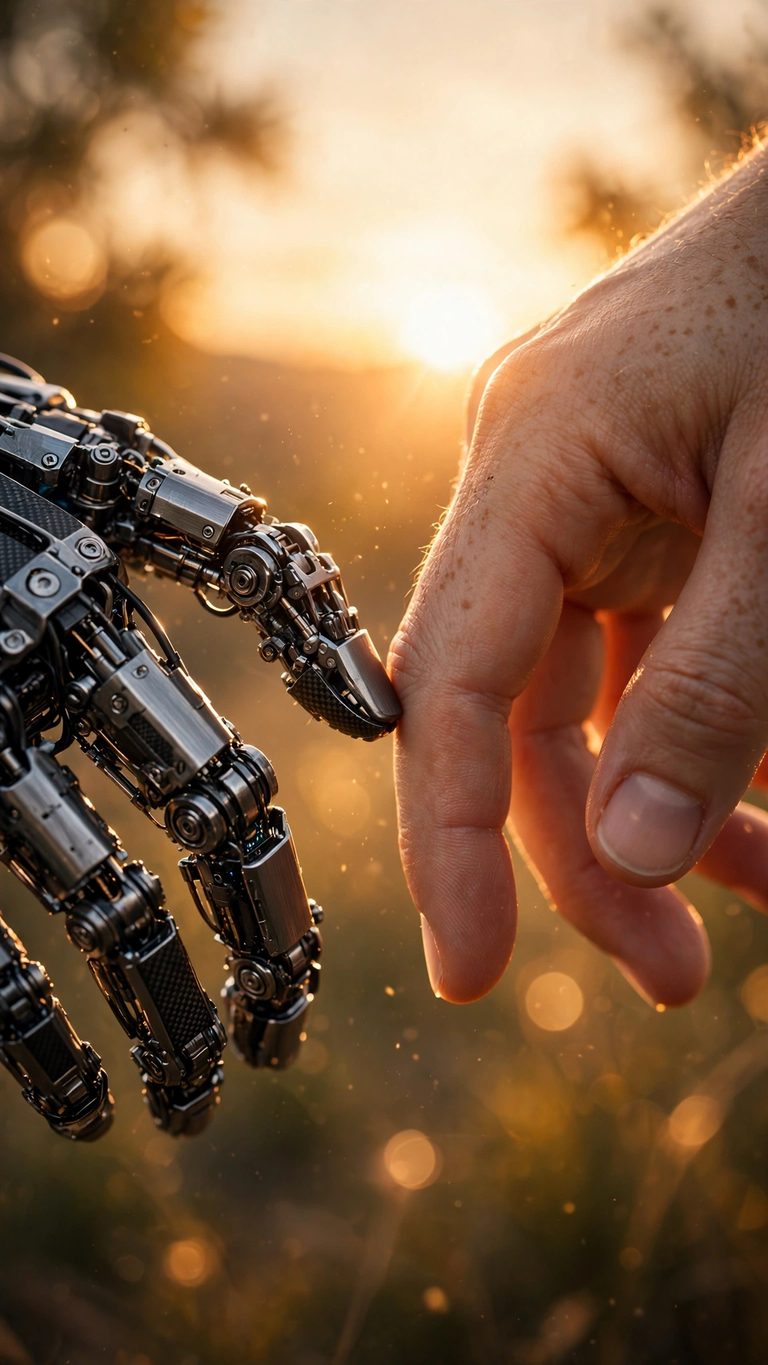
Two fingertips, meeting in warm sunset light. One is flesh; the other is machine. It is the simplest possible composition — a close-up, a touch, a backlight — and it carries the entire story of our century in a single frame. This AI photo prompt recreates that iconic gesture: a robotic hand gently touching a human hand, shallow depth of field dissolving the world into gold, the contact point rendered in hyper-detailed sharpness. It is the ‘Creation of Adam’ for the AI age.
The power of the image is that it refuses to pick a side. It is not a warning about robots and not a celebration of them — it is a question, held in the space between two fingertips. The warm sunset backlight bathes both hands in the same forgiving glow, suggesting kinship rather than conflict. Viewers bring their own hopes and fears to that touch, which is exactly why the image travels: everyone who shares it is really sharing what they believe about the future.
For creators, this is prestige content. The cinematic mood, the symbolic weight, and the flawless close-up craft signal serious visual intent — the kind of image that anchors a portfolio, opens a presentation, or becomes the defining post of a tech brand’s feed. It is also remarkably versatile: hopeful, philosophical, romantic, or cautionary depending on the caption you pair it with.
The Prompt
Here is the exact prompt behind this emotional close-up. Copy it word for word into your AI image generator.
Emotional close-up photograph of a robotic hand gently touching a human hand, fingertips meeting, warm sunset backlight, shallow depth of field, symbolic connection between man and machine, cinematic mood, hyper-detailed textures, ultra sharp, 8k, photorealistic
Why This Prompt Works
The first reason this prompt works is the depth of its symbolism. The fingertip touch is one of humanity’s oldest visual metaphors — from Michelangelo’s Sistine Chapel to E.T.’s glowing finger — and this prompt plugs directly into that archetypal wiring. ‘Symbolic connection between man and machine’ is not just descriptive text; it instructs the generator to compose with meaning, and it primes the viewer to read the image as significant. Archetypes are shareability cheat codes: they let an image borrow thousands of years of emotional resonance in a single glance.
Second, the prompt is built on a hope narrative, and hope outperforms fear in share metrics across nearly every platform study of emotional content. The warm sunset backlight is doing deliberate emotional labor: sunsets signify endings that are also beautiful, transitions rather than terminations. A robotic hand rendered in golden-hour warmth reads as a partner, not a threat. People share hope-forward images to signal their own optimism — the post becomes a small manifesto, and manifestos get passed along.
Third, the cinematic craft makes it thumb-stopping. Shallow depth of field isolates the contact point so the eye has exactly one place to land; the hyper-detailed textures reward the zoom-in impulse; the backlight creates a natural halo that separates the hands from the background. At thumbnail size, the image reads as a glowing abstract — intriguing enough to earn the tap. At full size, it delivers the emotional payload. That two-stage reveal (intrigue, then meaning) is the structure of the most successful visual posts.
Finally, the moment is culturally perfectly timed. As AI systems become daily collaborators, the public conversation oscillates between anxiety and wonder — and this image sits exactly at the fulcrum, refusing to resolve the tension. Content that crystallizes an unresolved cultural feeling becomes a vessel for that conversation: it gets posted in debates, keynotes, classrooms, and op-eds. A prompt that generates the defining image of a debate has influence far beyond its like count.
How to Use This Prompt
DALL-E 3: DALL-E 3 is the strongest choice for this prompt because it excels at hands — historically the hardest subject in AI imagery — and at narrative warmth. Paste the prompt into ChatGPT’s image tool. Inspect the fingers carefully: count them, check the contact point, look for merged digits. If anything is off, use conversational editing (‘fix the robot’s fingers so there are five distinct digits touching the human fingertip’) rather than regenerating blind. DALL-E’s edit mode is the fastest path to anatomically clean hands.
Midjourney v7: Midjourney renders cinematic light and material contrast gorgeously — the brushed metal against warm skin will look stunning. Paste the prompt verbatim with –ar 2:3. Midjourney’s hands have improved dramatically, but still verify finger count and the exact point of contact. If the touch looks tentative or the hands do not quite meet, reroll with ‘fingertips firmly touching’ strengthened. The contact is the entire image; it must be unambiguous.
Flux: Flux delivers exceptional texture detail, which matters enormously in a hyper-detailed close-up. Use the prompt as-is at portrait ratio. Flux is particularly good at the interplay of hard robotic surfaces and soft human skin under backlight. If the sunset feels washed out, append ‘rich golden sunset backlight with visible glow around the hands’ to saturate the emotional lighting.
Pro Tips & Creative Variations
1. The fingertip contact must be tack-sharp. Everything in this image is negotiable except the point of touch. The prompt specifies ‘ultra sharp’ for a reason: the contact point is where the viewer’s eye lands and where the meaning lives. If the generator softens the contact into a blurry merge, the image loses its power. Generate multiple variants and select the one with the crispest fingertip meeting — then crop so that point sits near a rule-of-thirds intersection.
2. Keep the backlight warm and the background blurred. The recipe is: warm halo + soft nothing. If background elements creep into focus — a horizon line, buildings, trees — they compete with the hands for attention. Strengthen ‘shallow depth of field’ to ‘extremely shallow depth of field, background fully blurred into warm bokeh’ if needed. The hands should appear to float in pure golden atmosphere.
3. Explore the emotional variations. This composition is a template for an entire series about the human-machine relationship. Try: an elderly wrinkled human hand meeting a pristine robot hand (generations in dialogue); a child’s small hand touching a large gentle robot finger (trust); two robot hands with one human hand between them (collaboration); the same composition in cold blue moonlight instead of sunset (ambivalence). Each variation reframes the same gesture into a new chapter of the story.
4. Pair it with words that earn the image. This is one of the few AI images strong enough to carry a long caption. Write 100-200 words about what the touch means to you — hope, caution, curiosity — and let the image do the emotional work while the text does the intellectual work. Posts that combine a symbolic image with genuine reflection consistently outperform the image alone, because they give viewers something to agree with, argue with, and quote.
Frequently Asked Questions
Q: Why do the hands keep coming out deformed?
A: Hands remain the classic AI failure point because of their complex articulation. This prompt’s ‘hyper-detailed’ and ‘ultra sharp’ tokens help, but the real fix is process: generate in batches, zoom into every candidate, and discard any with wrong finger counts or merged digits. DALL-E 3 currently has the best hand anatomy; Midjourney v7 is close behind. Never publish a symbolic image with broken symbolism — deformed hands destroy the meaning instantly.
Q: Can I make the mood darker or more cautionary?
A: Yes. Replace ‘warm sunset backlight’ with ‘cold blue rim light in darkness’ and ‘cinematic mood’ with ‘tense ominous mood,’ keeping the composition identical. The same fingertip touch becomes a warning instead of a hope. This duality is a feature: post both versions as a diptych or carousel (‘two futures, one touch’) and let the audience debate which one we are heading toward — engagement will take care of itself.
Q: What captions work best with this image?
A: Captions that ask a question outperform captions that make a statement. Try: ‘When the future reaches out — do we take its hand?’ or ‘Partners or replacements? You decide.’ Philosophical open-endedness invites comments, and the image supplies the emotional gravity that makes the question feel worth answering. Avoid tech jargon; speak in human terms about trust, curiosity, and what comes next.
Q: Is this image appropriate for business or brand use?
A: Very — with the right framing. It is widely used by AI startups, consultancies, and conference organizers to signal human-centered technology. For commercial use, verify your generator’s licensing terms for your subscription tier, generate at maximum resolution, and consider a subtle brand-color grade in post. The warm sunset palette adapts well to most brand color stories with minor hue adjustments.
Every era gets the image it deserves, and ours may well be two fingertips meeting in golden light. Copy this AI photo prompt, generate your version of the touch, and share the frame that asks the defining question of our time — gently, beautifully, and without needing a single word.
Related Viral Prompts
- Vintage Robot Toys AI Photo Prompt: Shoot a Nostalgic 1950s Tin Robot Toy Still Life on a Wooden Shelf
- Robot Astronaut on the Moon: Epic AI Photo Prompt for a Heroic Earthrise Portrait That Instantly Goes Viral
- Glowing Robot Eye Macro: Intense AI Photo Prompt for Hyper-Detailed Futuristic Close-Up Portraits to Try Today
# A I P h o t o # P r o m p t B a z a r # R o b o t H a n d # E m o t i o n a l # C o n n e c t i o n


Leave a Reply