
Introduction
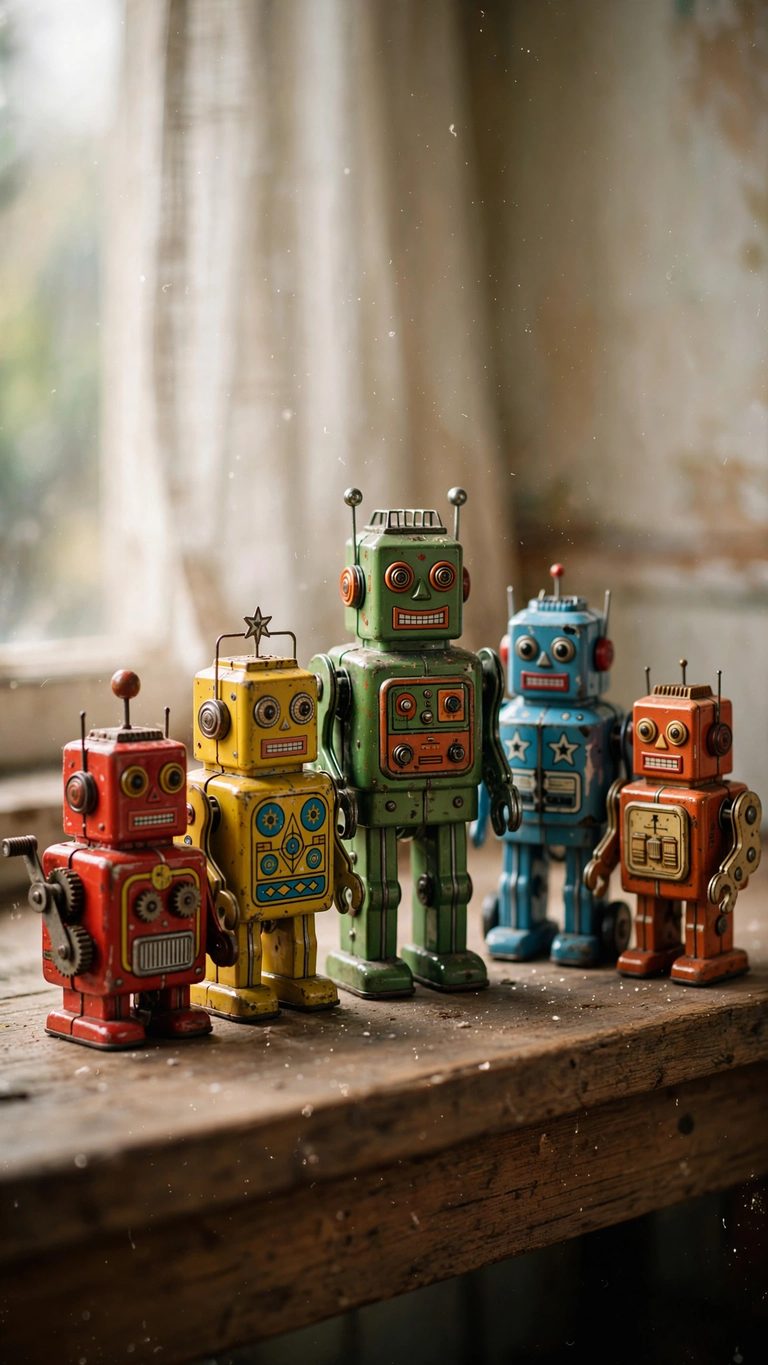
Before robots were real, they were toys — wind-up tin dreamers with riveted smiles, lined up on bedroom shelves by children who grew up to build the actual future. This AI photo prompt bottles that memory: a nostalgic still life of colorful vintage tin robot toys arranged on a wooden shelf, soft window light catching their lithographed paint, a whisper of dust in the air, warm film tones wrapping everything like a well-worn photograph. It is not just a picture of old toys. It is a time machine.
Nostalgia is the most underrated force in visual content. A single glance at a 1950s tin robot can detonate a chain reaction of memory — Saturday morning cartoons, grandparents’ attics, the particular smell of old metal and cardboard. This prompt is engineered to trigger exactly that cascade: the retro designs, the slight dust, the warm film tones are not decorative choices, they are memory cues, each one a small key turning in a different viewer’s past.
For creators, vintage subjects offer something modern tech imagery rarely does: instant warmth and zero intimidation. Nobody feels lectured by a tin toy. Collectors, photographers, retro-design lovers, and parents all find their own doorway into the image — and every doorway is a share, a save, or a comment that starts with ‘I had one of these.’
The Prompt
Below is the complete prompt, reproduced exactly as written. Paste it into your AI image generator to open the toy box.
Nostalgic still life photograph of colorful vintage tin robot toys lined up on a wooden shelf, soft window light, slight dust, retro 1950s designs, shallow depth of field, warm film tones, collector charm, ultra detailed, 8k, photorealistic
Why This Prompt Works
The primary engine here is toy nostalgia, and nostalgia is not a soft emotion in marketing terms — it is one of the strongest known drivers of purchase intent, brand warmth, and content sharing. The prompt’s ‘retro 1950s designs’ token targets a specific, potent memory cohort: the golden age of tin toys, space-race optimism, and mid-century design. Viewers do not just see robots; they see their childhood shelf, and the comment section becomes a reunion. Content that makes people remember together gets shared together.
Second, the still life aesthetic gives the image gallery credibility. Still life is one of photography’s oldest and most respected genres, and its visual grammar — careful arrangement, directional window light, shallow depth of field — signals craft to photography-literate audiences. ‘Collector charm’ and ‘warm film tones’ push the render away from sterile product photography and toward the beloved look of vintage camera forums and film-photography communities, which are among the most engaged visual audiences online.
Third, the collector community is a built-in distribution network. Vintage toy collectors are organized, passionate, and constantly hunting for imagery: they run groups, newsletters, auction listings, and reference wikis that all need visuals. An evocative, accurate tin-robot still life gets adopted by these communities as illustration, discussion fuel, and wishlist material. When a niche community adopts your image, you gain a durable, self-sustaining audience that a general feed can never provide.
Finally, the prompt’s restraint is its strength. ‘Slight dust’ and ‘soft window light’ are small, honest details that sell authenticity — the image feels found, not manufactured. In an era of hyper-polished AI imagery, a photograph that whispers instead of shouts stands out precisely because it underplays. Warmth plus restraint is a rare combination in generated imagery, and rarity is memorable.
How to Use This Prompt
Flux / Stable Diffusion: This prompt is tuned for Flux and Stable Diffusion, which excel at material realism — the lithographed tin, the wooden shelf grain, the film-tone grade. Paste the prompt verbatim at a portrait aspect ratio. In Stable Diffusion, consider a photorealistic checkpoint and keep the ‘ultra detailed, 8k, photorealistic’ tokens; they steer the model away from illustration styles. If the robots look too new, strengthen ‘slight dust’ and add ‘gentle wear, minor paint chips, aged patina’ to sell the vintage.
Midjourney v7: Midjourney renders nostalgic warmth and still life composition beautifully. Paste the prompt with –ar 2:3. Midjourney may idealize the toys into overly perfect condition — counteract with ‘worn vintage condition, authentic aging’ if you want honest collector-grade realism. Its film-tone rendering is excellent, so the ‘warm film tones’ token will sing here.
DALL-E 3: DALL-E 3 interprets ‘retro 1950s designs’ with strong period accuracy — expect boxy bodies, rivets, dial eyes, and rocket motifs. Paste the prompt into ChatGPT’s image tool. If the arrangement feels cluttered, ask for ‘fewer robots, more space between them, clean wooden shelf’ — DALL-E’s conversational editing is perfect for art-directing a still life after the first draft.
Pro Tips & Creative Variations
1. Vary the arrangement, not just the robots. A still life lives or dies on composition. Try a strict lineup (soldiers on parade), a clustered group with one hero robot in front, a diagonal cascade across two shelf levels, or a single robot centered with generous negative space. Generate the same prompt four times with different arrangement language and pick the strongest — or post all four as a carousel showing ‘the collection from every angle.’
2. Keep the dust subtle and the light soft. The prompt says ‘slight dust’ and ‘soft window light’ — honor the adjectives. Heavy dust reads as neglect; harsh light reads as interrogation. If your render comes out grimy or contrasty, soften with ‘gentle morning window light, airy, delicate dust motes in sunbeam.’ The goal is a sunbeam in a quiet room, not a crime scene.
3. Nail the 1950s design language. Authenticity is what makes collectors share. True 1950s tin robots have boxy lithographed bodies, visible rivets or tabs, spring or wheel feet, dial-and-needle chests, antennae, and primary-color paint with rocket-age graphics. If your generator produces sleek modern bots, add ‘boxy tin toy robots with lithographed details, rivets, and wind-up keys, 1950s Japanese tin toy style.’ Period accuracy is the difference between ‘cute robots’ and ‘I need to share this with my collector group.’
4. Grade for film, then stop. The ‘warm film tones’ token gets you most of the way, but a light post-grade seals the deal: lift the blacks slightly, warm the shadows, add the faintest grain. Then stop — over-grading is the fastest way to make a good still life look like an Instagram filter from 2014. Restraint in post matches restraint in the prompt.
Frequently Asked Questions
Q: How do I get authentic-looking vintage robots instead of modern ones?
A: Anchor the era explicitly: ‘1950s tin toy robots, boxy lithographed metal bodies, visible rivets, wind-up keys, dial eyes.’ Reference the classic Japanese tin toy style in your own words if the first render drifts modern. Avoid tokens like ‘sleek,’ ‘futuristic,’ or ‘chrome humanoid’ — they pull the design forward in time. The prompt’s ‘retro 1950s designs’ is your anchor; reinforce it rather than replacing it.
Q: My still life looks flat. How do I add depth?
A: Depth in still life comes from three things: layered arrangement (robots at different distances), shallow depth of field (already in the prompt — strengthen it if needed), and directional light with visible falloff. Ask for ‘robots arranged at varying depths on the shelf, front robot in sharp focus, rear robots softly blurred.’ A side-placed window light raking across the shelf will carve each robot out of the background.
Q: Can I feature a specific robot or add text like a brand name?
A: You can request a hero robot (‘one large red robot centered, smaller robots flanking it’), but AI generators mangle text — avoid asking for readable brand names or lithographed words on the toys, as you will likely get gibberish lettering. If you need a label, add it in post-production with a real font. For the robots themselves, describe shapes and colors, never text.
Q: What are the best uses for this image beyond social media?
A: Vintage robot still lifes are perfect for blog headers about retro tech, newsletter illustrations, Etsy-style shop banners for vintage sellers, children’s book spot art, and framed prints — the warm film tones print beautifully. Collectors also use evocative imagery in auction listings and collection catalogs. Generate a landscape variant for website heroes and keep the 9:16 for stories and pins.
Every tin robot on that shelf is a love letter from the future’s childhood — wind-up dreams from an age that imagined tomorrow in primary colors. Copy this AI photo prompt, arrange your own shelf of memories, and share the still life that makes the whole internet remember being eight years old.
Related Viral Prompts
- Robot Astronaut on the Moon: Epic AI Photo Prompt for a Heroic Earthrise Portrait That Instantly Goes Viral
- Glowing Robot Eye Macro: Intense AI Photo Prompt for Hyper-Detailed Futuristic Close-Up Portraits to Try Today
- Wholesome Robot Family Photo: Cute AI Photo Prompt for a Feel-Good Park Portrait Everyone Shares Today
# A I P h o t o # P r o m p t B a z a r # V i n t a g e R o b o t s # T o y s # N o s t a l g i a


Leave a Reply