
Introduction
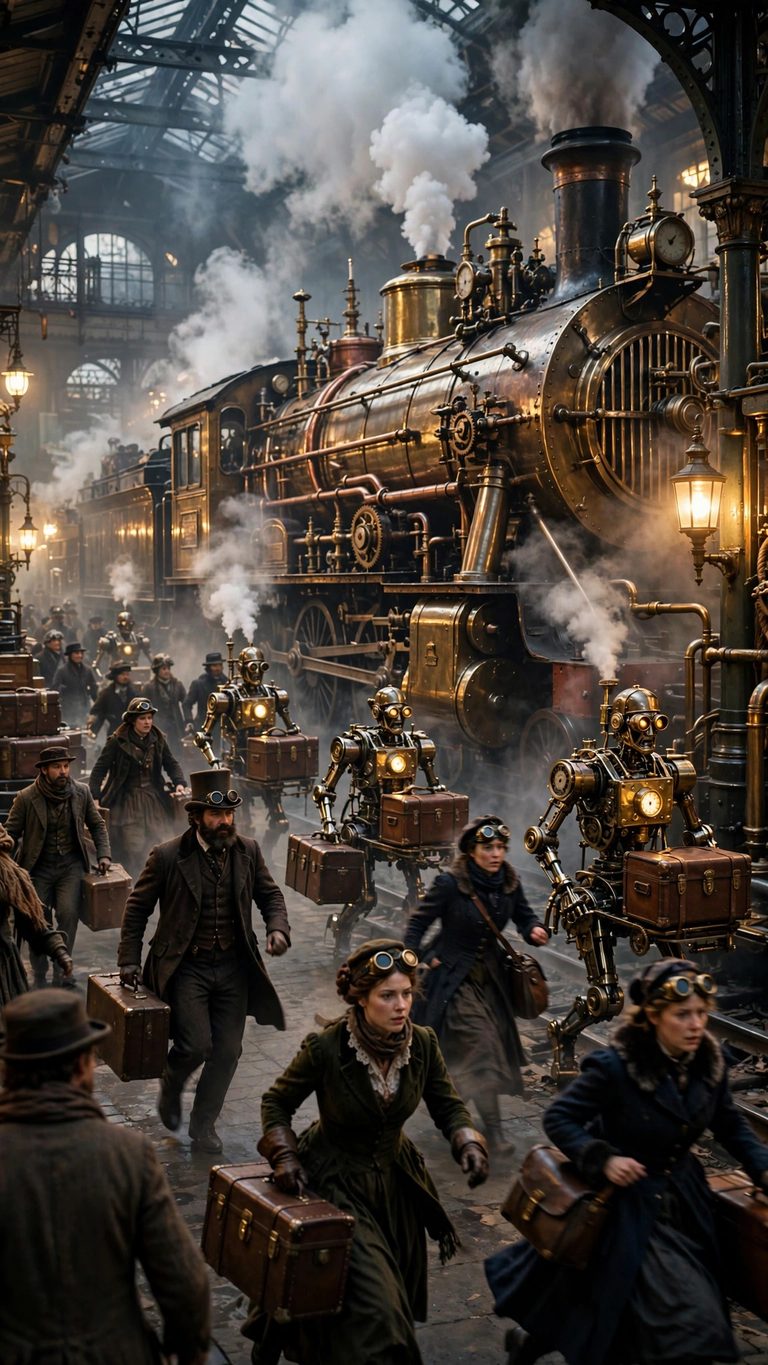
Step onto the platform and feel the heat on your face. A colossal brass steam locomotive towers over the crowd, hissing great white clouds that roll across the gaslit platform and swallow the far end of the station. Travelers in Victorian coats and brass goggles hurry past with leather trunks, clockwork porters clank by with impossible stacks of luggage, and the great departure boards clatter as they flip to reveal the next destination. The camera pushes through the energetic crowd, and you are not watching a station, you are in it.
Crowd scenes are the ultimate flex for AI video, because they are where older models fell apart into melting faces and drifting limbs. The Steam Station Crowd prompt leans directly into that challenge and wins, thanks to careful choreography: every group in the frame has a simple, readable motion, hurrying, carrying, hissing, flipping. In eight seconds it delivers the immersive period atmosphere that makes viewers feel the coal smoke in their lungs, and it does it in vertical format, ready for the feed.
The Prompt
Here is the exact prompt. Paste it into your generator unchanged for the first render, then customize from a position of strength.
Bustling steampunk railway station scene, a colossal brass steam locomotive hissing white clouds, travelers in Victorian coats and goggles hurrying with leather trunks, clockwork porters carrying luggage, departure boards flipping, warm gaslight glow, camera pushing through the energetic crowd, immersive period atmosphere, ultra realistic, cinematic
Why This Prompt Works
This prompt succeeds by giving a chaotic scene strict choreography. Each element has one clear motion: the locomotive hisses, travelers hurry, porters carry, departure boards flip. AI video models handle crowds far better when every figure has a simple, legible action rather than vague milling about, because simple limb trajectories are easier to interpolate across frames. The prompt also staggers its subjects by scale, the colossal locomotive as the immovable anchor, humans in the midground, flipping boards in the background, so the composition stays readable even while everything moves.
The sensory vocabulary is doing quiet, powerful work. Hissing white clouds gives the model volumetric steam to render, which is both gorgeous and forgiving, since steam naturally obscures fine detail where artifacts might appear. Warm gaslight glow sets the color grade in three words, pushing the palette toward amber and shadow instead of flat daylight. Immersive period atmosphere acts as a final style directive, nudging costumes, architecture, and props toward Victorian authenticity without the prompt having to enumerate every rivet.
The camera move, pushing through the energetic crowd, is the masterstroke. A forward push creates natural motion parallax, with near figures sliding past the lens while the locomotive looms larger ahead. That parallax is the single strongest depth cue in generated video, and it makes the viewer feel physically present on the platform. Closing with ultra realistic and cinematic keeps faces and brasswork photographic rather than stylized, which is exactly what a period piece demands.
How to Use This Prompt
Built for an 8-second vertical crowd push-through. Deploy it on Veo 3, Runway, Kling, Pika, or Sora like this:
- Set 9:16 vertical and an 8-second duration, matching the prompt’s energetic push-through pacing.
- Paste the prompt exactly, preserving the order of subjects from locomotive to travelers to porters to boards.
- Choose a forward push-in or dolly-forward camera preset if your tool offers one, reinforcing the through-the-crowd motion.
- Add a negative prompt such as melting faces, extra limbs, modern clothing, blurry, watermark to protect the crowd rendering.
- Generate several seeds and keep the take with the most stable faces in the foreground, then mix in station ambience, steam hisses, distant whistles, and hurried footsteps.
Crowd shots are the most seed-sensitive generations you will make. Budget for four to six attempts and judge them on the foreground figures, since viewers’ eyes go to the nearest faces first. A light film-grain overlay in post also helps blend any minor inconsistencies into a cohesive period texture.
Pro Tips & Creative Variations
The station is a stage you can redress for any story. A midnight departure with blue shadows and a single lit carriage window turns the bustle into mystery. A royal arrival, red carpets, brass bands, a locomotive polished to a mirror shine, turns it into ceremony. An abandoned version, the same platform empty, steam curling through shafts of dusty light, a single clockwork porter waiting, is pure melancholy and performs exceptionally well as a standalone art piece. Same architecture, different hour, completely different emotion.
Follow individual travelers for character-driven spin-offs. The woman in the green coat clutching a brass-bound trunk, the old engineer with oil on his cuffs tipping his goggles, the child waving from a carriage window as steam swallows the platform: each can be generated as a close-up insert using the same descriptive language, and cut together they become a short film about one departure. You can also swap the locomotive itself, a double-headed engine, a tiny clockwork shunter, or a locomotive with a glass-domed observation car, to keep the series fresh.
For maximum immersion, generate a matching point-of-view shot from the locomotive’s footplate, looking out over the boiler at the crowded platform ahead, and intercut it with the crowd push-through. Two perspectives of the same moment, described with consistent vocabulary, create the feeling of a directed scene rather than a single generated clip, and that perceived production value is what earns shares and saves.
Frequently Asked Questions
How do I avoid distorted faces in the crowd?
Keep the clip short, use a strong negative prompt with melting faces and distorted faces, and generate many seeds. Foreground faces matter most, so pick the take where the nearest figures look clean even if background faces are soft. Slight motion blur and film grain in post also hide minor issues convincingly.
Which AI video tool handles crowds best?
Veo 3 and Kling currently lead on crowd coherence, keeping multiple figures anatomically stable. Runway offers the best camera control for the push-through move, Sora renders the most atmospheric steam and gaslight, and Pika is the quickest way to iterate on seeds. Expect to generate more takes for crowd scenes than for single-subject shots on any platform.
Can I change this to a modern or sci-fi station?
Absolutely. The choreography, hissing engine, hurrying travelers, flipping boards, pushing camera, is era-agnostic. Swap Victorian coats for spacesuits, the brass locomotive for a maglev, and gaslight for neon, and the same prompt skeleton gives you a sci-fi departure. The structure is the valuable part; the dressing is interchangeable.
What is the best posting strategy for crowd scenes?
Post the 8-second clip natively to TikTok, Reels, and Shorts with station ambience audio rather than trending music, since authentic sound design makes crowd footage feel real. A caption that asks a question, like which platform would you board from, drives comments, and pinning the best comment keeps the conversation alive.
The Steam Station Crowd prompt turns the hardest shot in AI video, a living crowd, into eight seconds of pure Victorian momentum. Brass, steam, and a thousand small human stories, all pushing toward departure. Try this AI video prompt now and put your audience on the platform. Every whistle, footstep, and plume of steam will pull viewers deeper into your steampunk world.
Related Viral Prompts
- Airship Over Desert Canyon: Epic Steampunk AI Video Prompt of a Lone Brass Airship Drifting Over Misty Canyons at Dawn
- Brass Robot Butler AI Photo Prompt: Create a Regal Steampunk Android Portrait for 9:16 Instagram Posts
- Hot Air Balloon Race AI Photo Prompt: Capture a Thrilling Steampunk Balloon Festival at Dawn in Vertical 9:16
# A I V i d e o # P r o m p t B a z a r # S t e a m p u n k # S t a t i o n # V i c t o r i a n

Leave a Reply