
Introduction
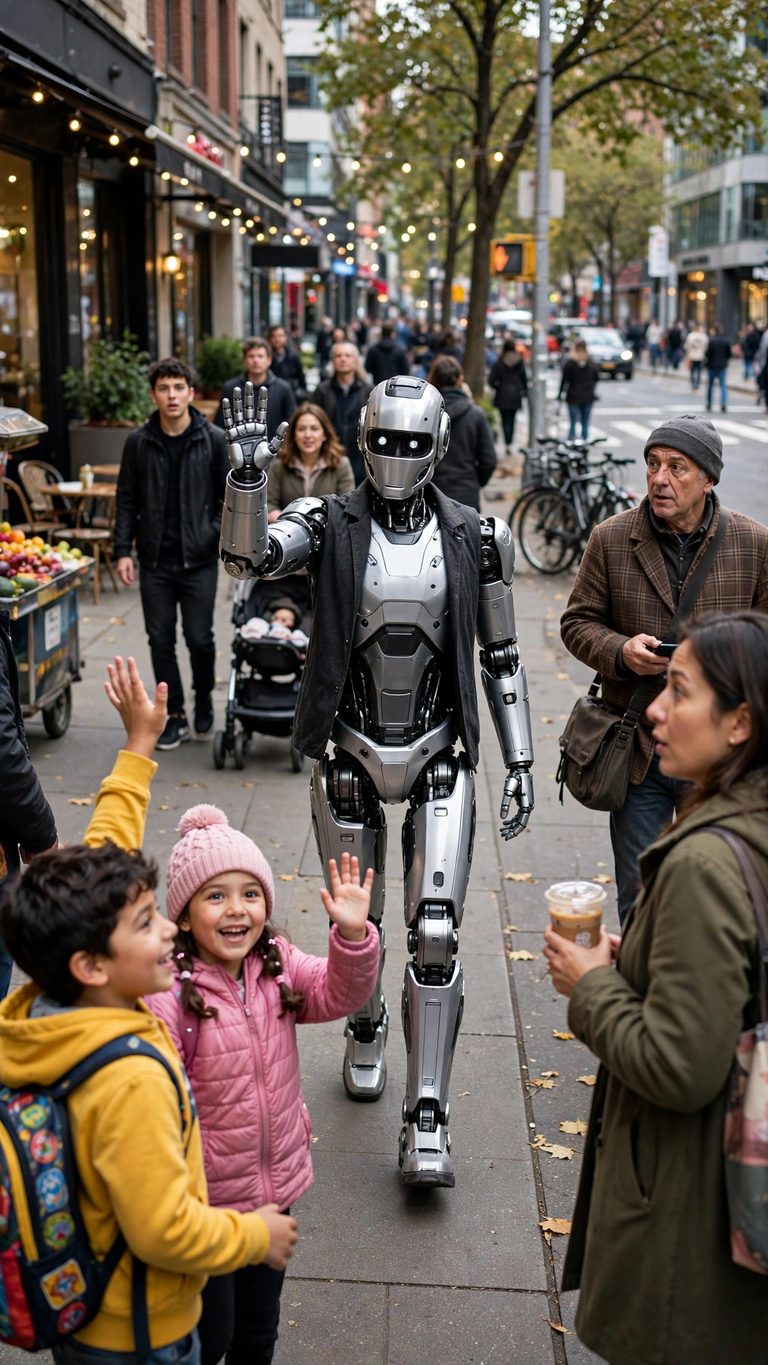
Picture this: you are walking down a busy city sidewalk when the crowd parts slightly and a lifelike humanoid robot strolls past you — calm, confident, utterly at ease among the humans. Heads turn. A child waves, delighted. The robot waves back, politely, like it does this every day. Someone’s phone is already out. Within hours, the clip is everywhere, and the comments are a mixture of amazement, disbelief, and one recurring question: wait, is this real?
That is the magic of the candid robot street scene, and it is one of the most potent viral formats of 2026. Unlike polished studio renders, this prompt is engineered to feel like found footage — a documentary fragment of a future that arrived early. The natural daylight, the smooth tracking shot, the authentic double-takes of pedestrians: every element conspires to make viewers feel like witnesses rather than an audience. And witnesses share. They tag friends, they debate authenticity, they stitch their own reactions. The video markets itself.
As humanoid robots move from laboratories to sidewalks in real life, public fascination with “robots among us” content has reached fever pitch. This prompt captures that cultural moment in eight perfectly composed seconds. Below is the exact prompt, a breakdown of the viral psychology powering it, and your step-by-step guide to creating a street scene so convincing it starts conversations.
The Prompt
Copy this prompt character-for-character into your AI video generator. The candid, documentary-style details are precisely what sell the realism — do not “improve” them on your first render.
Captivating street scene of a lifelike humanoid robot strolling through a busy city sidewalk, pedestrians turning heads in amazement, children waving, robot waving back politely, natural daylight, candid documentary feel, smooth tracking shot, ultra realistic, 8k, curious onlookers amazed today
Why This Prompt Works
The core engine here is “future shock” made watchable. Psychologists use that term for the disorientation of encountering tomorrow’s technology today, and it produces a uniquely shareable emotional state: the viewer feels amazed, slightly unsettled, and urgently compelled to show someone else. “Did you see this?” is the most powerful distribution mechanism on social media, and this prompt manufactures that exact sentence. The robot is not performing or demonstrating — it is simply strolling, which makes the scene feel like a leaked glimpse of everyday life five years from now rather than a staged demo.
The bystander reactions are the prompt’s masterstroke. “Pedestrians turning heads in amazement” and “children waving” embed authentic human response directly into the footage, and human brains are deeply wired for social proof — we calibrate our own reactions by watching others react. A lone robot on an empty street is a tech demo; a robot surrounded by amazed onlookers is an event. The child waving is especially potent: children are perceived as honest reactors, so their delight certifies the scene’s wonder for adult viewers. When the robot “waves back politely,” it completes a tiny social loop that feels profoundly human, dissolving the boundary between machine and neighbor in under two seconds.
The candid documentary aesthetic is the third pillar. “Natural daylight” and “candid documentary feel” deliberately avoid the glossy perfection that screams “AI render.” Slightly imperfect, sunlit, handheld-feeling footage bypasses viewers’ skepticism filters — it looks like something a passerby filmed, which is exactly why the “is this real?” debate ignites in the comments. That debate is pure engagement gold: authenticity arguments drive comment depth, stitches, and duets, while the tracking shot’s smooth forward motion keeps eyes locked for the full eight seconds. In a year when real humanoid robots genuinely are appearing in public, the line between this prompt’s fiction and reality is thrillingly thin — and thin lines get shared.
How to Use This Prompt
Step 1: Choose your generator for realism and motion. Veo 3 leads on photorealistic humans and natural daylight. Kling 2 is superb at the smooth tracking shot and natural walking motion. Runway offers precise camera path control for the tracking move, Sora handles crowd scenes well, and Pika is great for rapid test renders.
Step 2: Paste the prompt exactly; set 9:16 vertical, 8 seconds. Vertical is non-negotiable — this must look like phone footage a bystander captured. Keep every documentary cue in the prompt intact on your first generation.
Step 3: Generate four to five takes and audit the crowd. Crowd scenes are where AI video most often glitches: melting faces, extra limbs, pedestrians walking through each other. Scrub through each take and choose the one with the cleanest background humans. The robot itself is usually fine; the bystanders decide the winner.
Step 4: Protect the candid feel. If the footage looks too polished, resist the urge to add cinematic color grading — the slightly raw look is the point. If the robot’s walk looks stiff, add “natural relaxed human-like gait” and regenerate.
Step 5: Publish like a witness, not a studio. Caption it as if you stumbled on the scene: “Just saw this walking downtown today.” Always include AI-generation disclosure to stay honest and platform-compliant — the disclosure does not kill the magic if the footage is strong. Add location-flavored hashtags and let the “is it real?” conversation do your distribution work.
Pro Tips & Creative Variations
Authenticity lives or dies in three details. Keep pedestrian reactions natural and varied — not everyone should stare; a mix of double-takes, smiles, phone-raising, and people simply walking past sells reality far better than a uniform gasp. Keep the robot’s walk smooth and unhurried with a natural arm swing; a gliding or jerky robot reads as CGI instantly. And preserve the daylight candid feel — bright, slightly high-contrast sun, everyday street clutter, no dramatic color grade. The moment it looks like a movie, the “found footage” spell breaks.
The variation potential is enormous because the city is an endless set. Move your robot to a park where joggers do double-takes, a subway platform where commuters glance up from their phones, a beach boardwalk at golden hour, or a rainy night street with neon reflections for a blade-runner mood. Change the robot’s activity: hailing a taxi, buying coffee from a street cart, waiting at a crosswalk like a model citizen — mundane activities in a robot body are comedy and wonder at once. Build a recurring character with a consistent design and drop “sightings” across different city locations as a series; followers will start treating your robot like a local celebrity. For maximum debate fuel, film-style grain and a subtle timestamp overlay push the found-footage illusion even further.
Frequently Asked Questions
Q: Is it ethical to make AI footage that looks like a real street sighting?
A: Yes, provided you disclose clearly that it is AI-generated — in the caption and ideally as on-screen text. The disclosure keeps you honest while barely denting the fun; audiences enjoy the illusion when they know it is an illusion. Never present it as genuine news footage or tag a real location as if it happened there.
Q: The background pedestrians keep glitching. Any fixes?
A: Reduce crowd density in your mental target: takes with fewer, well-separated bystanders glitch less than packed crowds. Generate more takes than usual for crowd scenes — five or six is normal — and pick the cleanest. Describing pedestrians with simple actions (“walking,” “glancing”) rather than complex ones also reduces artifacts.
Q: Should the robot look friendly or neutral?
A: Friendly, but subtly. The polite wave in this prompt is the perfect calibration — approachable without being cartoonish. An overly expressive robot breaks the documentary realism; a blank one feels menacing. Polite and calm is the viral sweet spot.
Q: Which platform performs best for this format?
A: TikTok and Instagram Reels lead for “is this real?” debate content because their comment and stitch cultures amplify exactly this dynamic. YouTube Shorts is strong for the series version, where subscribers follow each new “sighting.” Post natively to all three.
The most powerful videos do not feel like videos at all — they feel like moments you happened to witness. This prompt manufactures that feeling with documentary precision: daylight, a crowd, a wave, and a machine walking among us like it belongs. Paste the prompt, render your sighting, and drop it on the feed with a straight face. Then watch the comments section turn into the best focus group on the internet.
Related Viral Prompts
- Robot Barista Latte Art AI Video Prompt: The Coziest Viral Coffee Moment You Will See Right Now in 2026
- Robot Dog Fetch AI Video Prompt: Create a Heartwarming Slow-Motion Frisbee Catch in a Sunny Park Today
- Neural Network AI Video Prompt: Dive Through a Glowing Abstract Brain of Pulsing Nodes and Data Rivers
# A I V i d e o # P r o m p t B a z a r # H u m a n o i d R o b o t # C i t y # V i r a l



Leave a Reply