
Introduction
Smaller than your fingernail, nearly invisible against the coral it calls home, the pygmy seahorse is one of nature’s greatest hide-and-seek champions. Marine photographers consider finding one the holy grail of macro diving: it takes expert guides, eagle eyes, and serious patience. This AI photo prompt skips the search entirely and delivers the treasure straight to your screen.
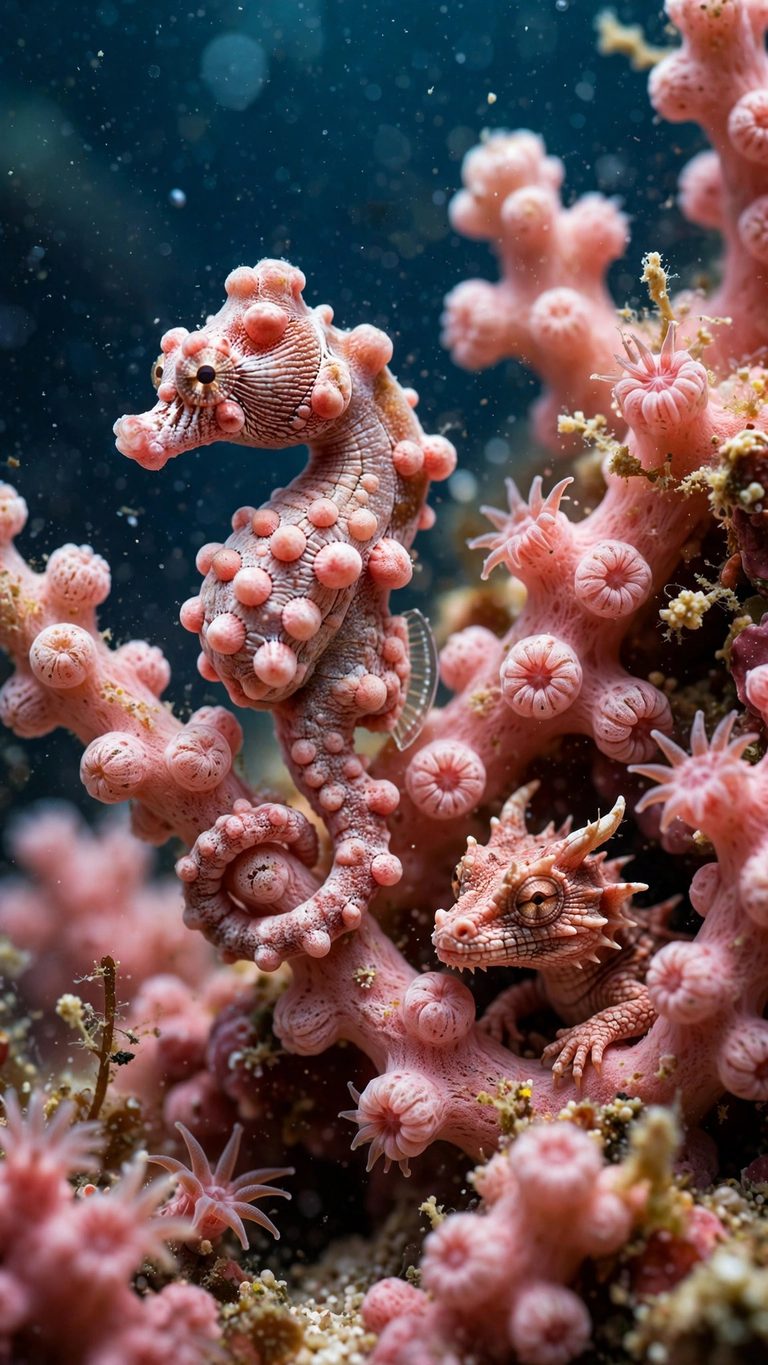
The prompt renders an exquisite macro photograph of a pygmy seahorse camouflaged on coral, its bumpy pink skin matching the surrounding polyps so perfectly it nearly disappears. A curled tail grips the coral, independent eyes swivel with quiet intelligence, and the whole creature reads like a tiny dragon hiding in plain sight. It is the kind of image that makes viewers lean closer to their screens.
Macro and “hidden animal” content has a special power on social feeds: people love the game of spotting the creature. A pygmy seahorse post practically begs for the caption “can you find it,” and that single question drives comments like nothing else. This #AIPhoto prompt gives you the perfect specimen for that game.
The Prompt
Copy the prompt below exactly as written, then paste it into your AI image generator of choice.
Exquisite macro photograph of a pygmy seahorse camouflaged on coral, smaller than a fingernail, bumpy pink skin matching coral polyps, curled tail, independent eyes, hidden miniature dragon, ultra detailed, 8k, professional macro underwater photography, photorealistic
Why This Prompt Works
Macro prompts fail when they are vague about scale, and this one is obsessively specific. “Smaller than a fingernail” gives the model a concrete real-world reference, which is far more effective than “tiny” or “small.” Models trained on captioned photos have learned what fingernail-scale subjects look like, so the reference calibrates the proportions of the seahorse against the coral around it.
The camouflage description is the prompt’s secret weapon. “Bumpy pink skin matching coral polyps” does two things at once: it describes the seahorse’s texture (bumpy, not smooth) and it instructs the model to blend subject and background through color and pattern matching. That is exactly how real pygmy seahorses look, and it is also what makes the image fascinating. Without the matching instruction, models tend to render a clean, isolated seahorse on a blurred background, pretty but far less captivating.
Anatomical specifics, “curled tail, independent eyes,” prevent the melted, generic look that plagues AI animal close-ups. Each named body part is a checkpoint the model tries to render correctly. “Hidden miniature dragon” sets the emotional register, playful wonder, in three words. And the quality chain “ultra detailed, 8k, professional macro underwater photography, photorealistic” is especially important here: macro photography is defined by extreme sharpness and shallow depth of field, and those tokens push the model toward tack-sharp focus on the seahorse with creamy coral bokeh behind it.
How to Use This Prompt
Macro detail demands the right settings. Here is the platform-by-platform playbook.
Midjourney: Paste the full prompt with --ar 9:16 --v 7. Midjourney v7’s detail rendering is superb for macro work. If the seahorse blends in too well and vanishes entirely, add “seahorse clearly visible, sharp focus on the seahorse” to rebalance. Use Upscale and then Vary (Subtle) to perfect the eye detail, which is where macro shots live or die.
DALL-E 3: DALL-E 3 follows the camouflage instruction faithfully, sometimes too faithfully. After generating, inspect whether the seahorse is findable; if not, use a conversational edit like “make the seahorse slightly more visible against the coral while keeping the camouflage realistic.” Generate at the largest size available for maximum texture.
Flux: Flux shines at fine texture, which is everything in macro. Use the full prompt at high resolution (1024×1792 if your interface allows). If polyps look mushy, strengthen with “razor-sharp macro focus, individual coral polyps clearly defined.” Generate several seeds; macro compositions vary wildly, and the third or fourth is often the keeper.
Pro Tips & Creative Variations
The pygmy seahorse is your gateway into an entire macro universe. Once this prompt works, reskin it: “pygmy octopus on coral,” “skeleton shrimp on a sea fan,” “nudibranch on sponge,” each with the same camouflage-matching structure. A feed of hidden miniature creatures becomes instantly recognizable, and followers start playing the spotting game on every post.
Experiment with the reveal. Generate two versions: one where the seahorse is nearly invisible, and one with “seahorse clearly visible in sharp focus.” Post them as a before-and-after or a swipe carousel titled “now you see it.” Interactive formats like this double engagement because viewers feel rewarded for looking closely. You can also try “extreme macro of the seahorse’s eye” for an abstract, alien-looking art piece.
Color-match experiments are endless. Real pygmy seahorses come in pink, yellow, and purple morphs matched to their host coral. Try “yellow pygmy seahorse on yellow coral” or “purple morph on purple sea fan” to build a color series. Add “black background macro style” for a dramatic studio look that makes the creature glow like a jewel. Pair the final image with a real fact, pygmy seahorses were only described by science in 1969, and your #AIPhoto post becomes both beautiful and educational.
Frequently Asked Questions
Q: My seahorse is completely invisible in the coral. Is that a fail?
A: Not necessarily, lean into it with a “can you spot it” caption. But if you want it findable, add “seahorse in sharp focus, slightly distinct from background” to pull it forward while keeping the camouflage believable.
Q: Why do AI models struggle with seahorse anatomy?
A: Seahorses have unusual anatomy, curled tails, coronets, horse-like snouts, that appears less often in training data than, say, cats. Naming each part in the prompt (“curled tail, independent eyes”) gives the model explicit checkpoints and dramatically reduces deformities.
Q: Which generator is best for macro texture?
A: Midjourney v7 leads on fine surface detail like bumpy skin and coral polyps. Flux is excellent at high resolutions. Both beat DALL-E 3 for raw macro sharpness, though DALL-E 3 follows camouflage instructions most literally.
Q: Can I print a macro AI image as wall art?
A: Yes, if you upscale first. Generate at the highest resolution, run it through an AI upscaler to 4K or higher, and check the eye and skin texture at 100 percent zoom before printing. Macro art prints beautifully at large sizes.
The pygmy seahorse proves that the smallest subjects make the biggest impressions. With this macro prompt, you hold nature’s tiniest dragon in your hands, no dive boat required. Generate your hidden treasure, challenge your followers to spot it, and enjoy the flood of comments from delighted viewers.
Related Viral Prompts
- Heavenly Sunbeam Reef AI Photo Prompt: Create a Divine Underwater Cathedral with Light Pillars and Coral Beauty
- Master of Disguise Octopus AI Photo Prompt: Capture Camouflaged Texture-Shifting Skin in Ultra Detailed Art
- Scuba Diving Coral Reef AI Video Prompt: Thrilling First-Person Dive Through Sunlit Turquoise Water Scenes
# A I V i d e o # P r o m p t B a z a r # A I P h o t o # S e a h o r s e # M a c r o


Leave a Reply