
Introduction
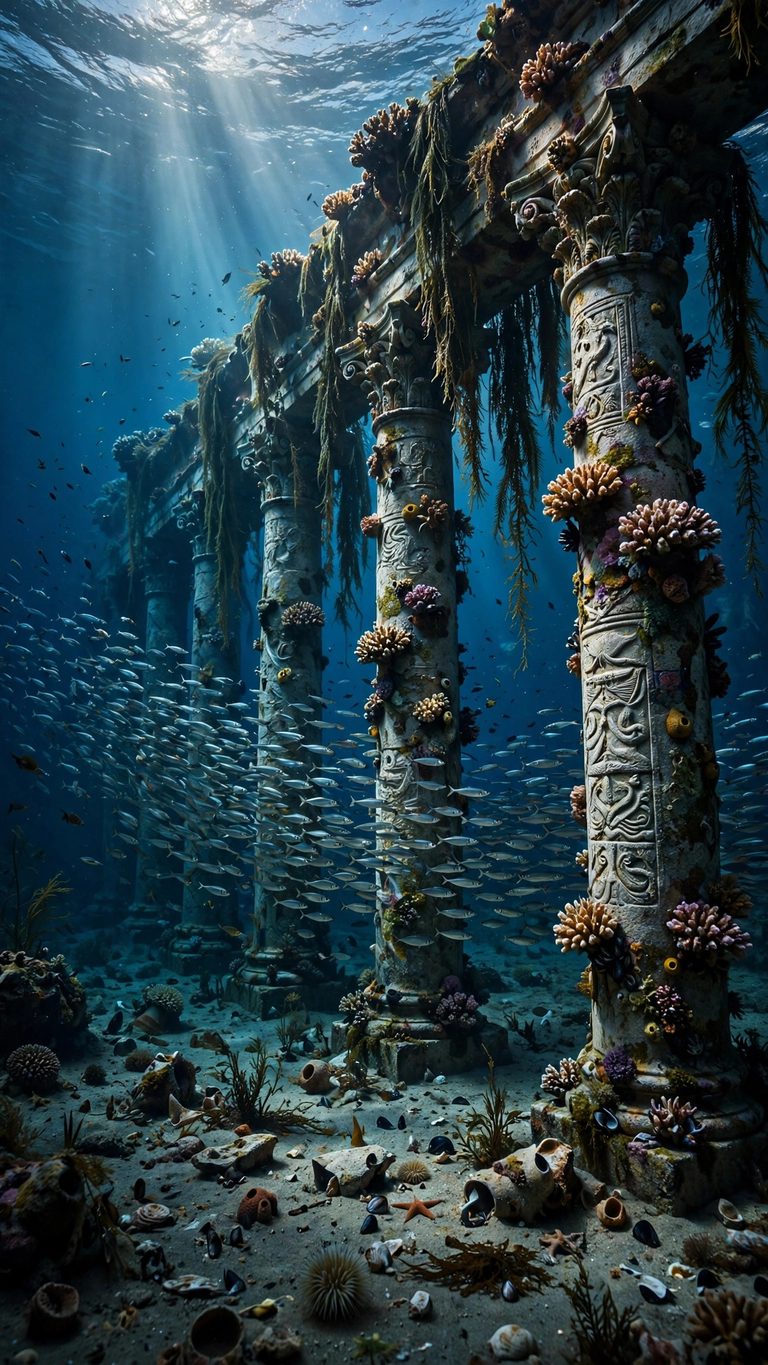
Somewhere beneath the waves, the story goes, a city is waiting. It might be a drowned temple off a forgotten coast, a Roman harbor swallowed by an earthquake, or a myth that never needed to be true to feel true. Underwater ruins hit a nerve that no other subject quite reaches: they are history and mystery fused together, human ambition humbled by the sea, columns that once held up roofs now holding up nothing but the weight of the water. But the image lives in all of us anyway, fed by documentaries, adventure films, and half-remembered legends of Atlantis. This AI photo prompt conjures that lost world on demand: ancient stone columns on the ocean floor, coral encrusting their capitals, a blade of blue light revealing carved reliefs, fish schooling through the colonnade, seaweed draping like curtains. In this guide you will get the exact prompt, a breakdown of why its atmosphere engineering works so well, and step-by-step instructions for Midjourney, DALL-E 3, and Flux. Perfect for fantasy art, book covers, and anyone who has ever dreamed of the #UnderwaterRuins that time forgot.
The Prompt
Copy the prompt below exactly as written, then paste it into your image generator of choice:
Haunting photograph of ancient stone columns on the ocean floor, coral encrusted capitals, a shaft of blue light illuminating carved reliefs, fish schooling through the colonnade, seaweed draping like curtains, lost world atmosphere, ultra detailed, 8k, professional underwater photography, photorealistic
Why This Prompt Works
Atmosphere is the hardest thing to prompt because it is the sum of a dozen small decisions, and this prompt makes every one of them correctly. It opens with “Haunting photograph,” an emotional art direction that immediately steers the palette toward deep blues, the contrast toward the dramatic, and the mood toward awe rather than cheer. “Ancient stone columns on the ocean floor” establishes the subject with architectural specificity: columns, not rubble, which gives the model strong vertical forms to compose around. “Coral encrusted capitals” is the detail that sells the age. Anyone can prompt “old ruins,” but specifying that coral has colonized the carved tops of the columns tells a story of centuries underwater, and it gives the model a concrete texture task – rough coral over smooth carved stone – that produces rich, believable surfaces. Then the lighting: “a shaft of blue light illuminating carved reliefs.” This is cinematography in a phrase. A single shaft, not general brightness, which creates the chiaroscuro drama of a real ruin dive, and it has a narrative job too: the light reveals the reliefs, giving the viewer’s eye a destination and implying that something worth discovering is carved into the stone. “Fish schooling through the colonnade” adds life, scale, and motion; a school threading between columns also reinforces the architecture, because the fish trace the negative space of the colonnade and make its geometry readable. “Seaweed draping like curtains” is another simile-to-visual translation, giving the vegetation a specific behavior – hanging, swaying, theatrical – rather than generic underwater plants. “Lost world atmosphere” is the mood summary that harmonizes all these elements and nudges the model toward the romantic, mysterious register of adventure cinema. The closing stack – “ultra detailed, 8k, professional underwater photography, photorealistic” – keeps the render grounded in photographic reality rather than drifting into fantasy illustration, which is a deliberate choice: photorealistic ruins feel discovered, while illustrated ruins feel invented, and discovery is the more powerful fantasy. The prompt’s genius is that it never names Atlantis or any specific legend, leaving the mythology to the viewer’s imagination, which is always more potent than anything spelled out. That open-ended mystery is why #UnderwaterRuins imagery built on prompts like this gets saved, shared, and used for everything from novel covers to game concept art.
How to Use This Prompt
Ruins are complex scenes with architecture, so give the model room to compose and be ready to curate.
- Midjourney: Paste the prompt with
--ar 9:16 --v 7 --style raw. Ruins benefit from raw mode’s structural honesty. If columns lean or melt, add--chaos 10for variety across seeds and pick the generation with the straightest architecture. - DALL-E 3: Paste the prompt and add “vertical 9:16, symmetrical colonnade receding into blue distance.” DALL-E 3 handles architectural perspective well but can clutter the scene; if it adds too many elements, remove “seaweed draping like curtains” for a cleaner composition.
- Flux: Paste verbatim at 9:16 with guidance around 3.5. Flux renders stone texture and light shafts beautifully, making it a strong choice for this particular prompt.
- Check the architecture: Inspect column alignment and capital shapes at full size. AI models sometimes merge two columns into one or carve impossible reliefs; choose the seed where the colonnade reads as a believable structure.
- Grade for mystery: Upscale, deepen the blues slightly, lift the light shaft with a gentle radial exposure boost, and add a whisper of grain. A subtle vignette will pull the eye toward the illuminated reliefs.
Pro Tips & Creative Variations
This prompt is a doorway to an entire lost civilization, and small edits open new rooms. Change the culture by swapping the architecture: “Egyptian temple pylons with hieroglyphs” for a Nile-drowned fantasy, “Mayan stepped pyramid” for a cenote mystery, or “Greek amphitheater” for a Mediterranean legend. Each keeps the underwater grammar intact while telling a different story. Time of day transforms the mood: “bioluminescent plankton glowing between the columns at night” turns the ruin into something enchanted, while “storm-dark water, columns emerging from gloom” goes full gothic horror. For a discovery narrative, add “a lone diver with a torch, tiny in frame, light beam joining the blue shaft” – the human figure supplies scale and turns the image into an adventure poster. A popular diptych is “above and below”: generate the ruin as written, then a second image of “the same columns at the surface at sunset, waves breaking over submerged capitals” for a split-world story. Writers and game designers can use this prompt for worldbuilding: generate five variations with different seeds, pick the most evocative, and let the details – the reliefs, the coral, the light – inspire names, histories, and plot points. For book covers, the vertical 9:16 format is already perfect; add generous dark water at the top in your edit for title space, since designers always need headroom for typography. A cinematic variation replaces “photograph” with “cinematic film still, anamorphic lens flare in the water” for key art that feels like a movie that should exist. And for the truly ambitious, chain the still into video: “camera drifts slowly through the colonnade, fish part around the lens, light shaft sways” creates a haunting establishing shot for a trailer or title sequence. Keep a consistent seed family when building a series so the ruins feel like one place rather than five different ones; continuity is what turns pretty pictures into a believable lost world. However you vary it, protect the light shaft – it is the soul of the composition, the thing that makes viewers lean in and wonder what the reliefs depict.
Frequently Asked Questions
Q: How do I keep the columns from looking melted or crooked?
A: Architectural elements challenge diffusion models, so generate multiple seeds and curate hard for straight verticals. Adding “perfectly vertical columns, classical proportions” helps, and generating at higher resolution gives the model more pixels to resolve the geometry. Discard any image where columns merge; no amount of editing fixes broken architecture convincingly.
Q: Can I make the ruins look like a specific ancient culture?
A: Yes, and it works well because the model has strong visual priors for Egyptian, Greek, Roman, and Mayan architecture. Name the culture and one signature element, like “hieroglyph-covered” or “Doric capitals,” and keep the underwater phrases unchanged. The fusion of a recognizable style with the ocean setting is what makes these images so compelling.
Q: Is this prompt good for book covers?
A: Excellent. The vertical format, the dark negative space at the top for titles, and the built-in mystery make it nearly purpose-built for fantasy and adventure covers. Generate at the highest resolution available, leave headroom for typography, and check your generator’s commercial license before publishing.
Q: How is this different from just prompting “Atlantis”?
A: Naming Atlantis pushes the model toward cliche – domes, tridents, and glowing crystals from a thousand movie posters. This prompt describes physical specifics instead: columns, capitals, reliefs, light. Specifics produce originality, while famous names produce stereotypes. Your lost city will feel more real because you built it from stone rather than from myth.
Every lost city is really a mirror: we imagine ruins underwater because we want to believe that beauty outlasts us. This prompt gives you the columns, the coral, and the light – the rest of the story is yours to tell. Copy it, choose your civilization, and build the drowned world you have always pictured. Then share it with the #UnderwaterRuins dreamers; somewhere out there, another Atlantis obsessive is waiting to see exactly what you saw.
Related Viral Prompts
- Ethereal Glowing Jellyfish AI Photo Prompt: Craft Stunning Bioluminescent Deep-Sea Art with Pink and Violet Light
- Whale Shark vs Tiny Diver AI Photo Prompt: Capture Mind-Blowing Ocean Scale with Ultra Detailed Photorealism
- Pygmy Seahorse Macro AI Photo Prompt: Capture Hidden Miniature Dragons in Stunning Ultra Detailed Close-Up Art
# A I V i d e o # P r o m p t B a z a r # A I P h o t o # U n d e r w a t e r R u i n s # M y s t e r y


Leave a Reply