
Introduction
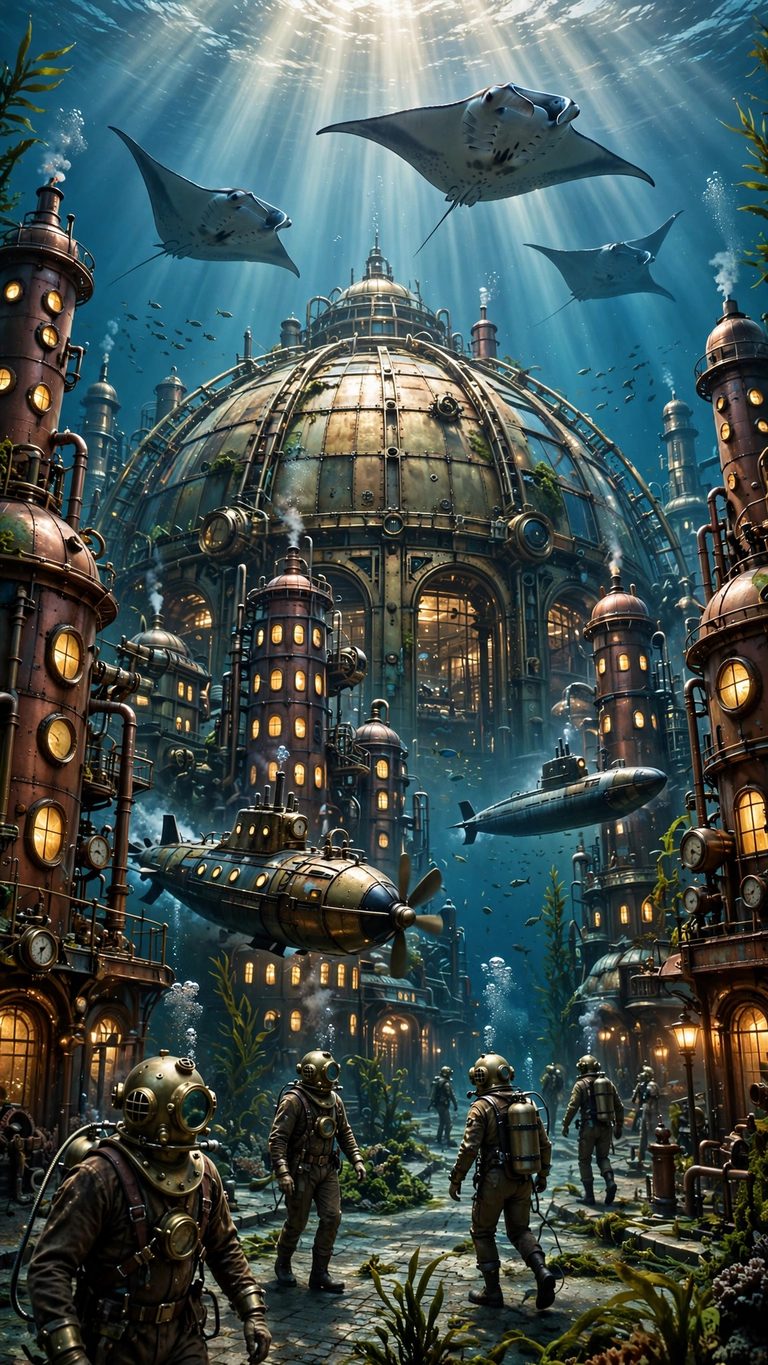
Twenty thousand leagues beneath the waves, a city glows. Copper towers rise from the ocean floor, their portholes burning warm against the blue dark, while brass-domed rooftops catch shafts of sunlight filtering down from a surface the citizens may never see. Submarines glide between the buildings like buses on a morning commute, giant manta rays sweep overhead, and divers in vintage helmets stroll streets that should not exist. This is the Jules Verne fantasy made visible, and our AI photo prompt builds it in a single frame. Underwater steampunk is a rare and difficult subject: the model must balance two worlds at once, the weight and warmth of brass machinery and the fluid, light-scattering physics of the deep sea. This prompt solves that tension with carefully chosen details that tell the generator exactly how the two worlds meet. Whether you need concept art for a game, a breathtaking wallpaper, or the centerpiece of a retro-futurist art series, this prompt delivers a scene with genuine depth, both literal and emotional. In this guide we unpack why each phrase works, how to run the prompt on every major image model, and how to dive deeper with variations that explore the whole submerged civilization.
The Prompt
Copy the prompt below exactly as written and paste it into your favorite image generator. Every word has been tuned for maximum visual impact.
Fantastical steampunk photograph of a brass domed city on the ocean floor, glowing portholes dotting copper towers, submarines gliding between buildings, giant manta rays swimming overhead, divers with vintage helmets walking the streets, sunbeams piercing blue water, Jules Verne wonder, ultra detailed, 8k, masterpiece
Why This Prompt Works
This prompt is a lesson in controlled contrast. Its first masterstroke is the core collision it sets up: a brass domed city on the ocean floor. Brass domes belong to Victorian observatories and exhibition halls, so placing them on the seabed instantly creates the impossible-but-tangible feeling that defines great steampunk. The model gets a clear architectural vocabulary, domes, copper towers, glowing portholes, which keeps the city coherent instead of dissolving into vague underwater ruins. The second masterstroke is the lighting design. Sunbeams piercing blue water is doing enormous work: it establishes the light source, the color palette of deep blue against warm brass, and the volumetric god-rays that make underwater scenes feel vast. Without that phrase, generators often produce murky, flat seascapes; with it, every surface gets direction and glow. Third, the prompt populates the city at three scales. Submarines gliding between buildings give mid-ground motion, giant manta rays swimming overhead add organic grace at the top of the frame, and divers with vintage helmets walking the streets provide human scale at the bottom. This three-layer composition is what makes the image read as a living city rather than a diorama. Fourth, the phrase Jules Verne wonder acts as a style anchor, pulling the model’s latent associations toward brass, rivets, and 19th-century adventure illustration rather than toward modern sci-fi or fantasy Atlantis. Finally, the quality stack of ultra detailed, 8k, and masterpiece ensures the fine work survives: rivet lines on the domes, reflections on the copper, the texture of the water itself. Each layer reinforces the others, which is why a single generation so often lands on the first try.
How to Use This Prompt
Follow these steps to get the best result on each major platform.
Midjourney: Paste the full prompt and add –ar 9:16 –v 7 –style raw. If the water looks too dark, add luminous water, clear visibility to brighten the scene. Use the Pan feature to extend the cityscape wider if you want a panoramic version of the metropolis.
DALL-E 3: Paste the prompt as-is. DALL-E 3 excels at honoring the three-scale composition, so the submarines, manta rays, and divers usually all appear where described. You can follow up with make the sunbeams more dramatic to push the lighting further without regenerating from scratch.
Flux: Paste the prompt unchanged at a portrait resolution such as 768 by 1344. Flux renders volumetric light and water caustics beautifully. Use 25 to 30 steps and a guidance value around 3.5, and consider adding cinematic color grading if the blues feel too cold.
Stable Diffusion: Use the prompt as your positive prompt with a negative prompt like muddy water, murky, low contrast, watermark, deformed. Thirty steps with DPM++ 2M Karras and CFG 7 works well. If the city looks sparse, add dense cityscape, many buildings to the positive prompt to fill the frame.
Pro Tips & Creative Variations
The submerged city is a world, not a single image, so treat the prompt as the establishing shot of a series. Change the district: describe a brass market quarter with divers haggling at stalls, a clockwork lighthouse on the city edge, or a grand opera house with a glass dome full of water and fish. Change the time and mood: a midnight version lit only by portholes and bioluminescent jellyfish is hauntingly beautiful, while a storm above the surface sending rippling light patterns down creates drama. Change the inhabitants: replace the divers with a brass submarine taxi queue, a parade of mechanical seahorses, or a giant octopus coiled peacefully around a tower like a guardian. Shift the era mashup: add art deco streamlining to the submarines for a 1930s Atlantis feel, or barnacled, half-sunken ruins at the city outskirts to suggest age and history. Play with the surface: describe the moment a diving bell descends from a ship above, connecting the two worlds, or a breach in a dome with water streaming in for pure action. You can also zoom in: a street-level view of divers walking past glowing shop windows, or a macro shot of a porthole with a curious face inside. Each variation reuses the prompt’s proven vocabulary of brass, copper, portholes, and sunbeams, so the series stays visually coherent while every image tells a new story from the deep.
Frequently Asked Questions
Why does my underwater city look murky instead of glowing? Murkiness usually comes from the model defaulting to deep-ocean darkness. Strengthen the light phrases: add crystal clear water, strong sunbeams from above, luminous. In Midjourney, the –style raw parameter keeps colors cleaner, and in Stable Diffusion a negative prompt with muddy and murky directly suppresses the problem.
How do I keep it steampunk instead of generic Atlantis? The Jules Verne anchor plus material words like brass, copper, riveted, and portholes are what hold the genre. If ruins or coral start taking over, add intact brass machinery, no ruins to the prompt to keep the industrial Victorian identity dominant.
Can I generate a wider landscape version? Yes. Switch to a 16:9 or 21:9 aspect ratio and add panoramic wide shot of the entire city in the prompt. Midjourney’s Pan feature and DALL-E 3’s wide size option both handle this well, giving you a sweeping establishing shot worthy of a film backdrop.
Which model handles water lighting best? Flux and Midjourney v7 both render volumetric sunbeams and water caustics convincingly, with Flux slightly ahead on fine light detail. DALL-E 3 is the most reliable at keeping all three composition layers, the submarines, rays, and divers, present in one frame.
Dive in. Paste the prompt, generate your brass metropolis, and stand on its glowing streets for a moment. Then pick one district from the variations above and expand your underwater world, one sunbeam at a time.
Related Viral Prompts
- Clockwork Butterfly Garden AI Photo Prompt: Hundreds of Brass Butterflies Fluttering Among Flowers in 8K
- Steampunk Observatory Night AI Photo Prompt: Grand Brass Dome and Copper Telescope Under a Starry Sky in 8K
- Brass Airship AI Video Prompt: Soar a Colossal Steampunk Airship Over Victorian London in Golden-Hour Glory
# A I P h o t o # P r o m p t B a z a r # S t e a m p u n k # U n d e r w a t e r # C i t y

Leave a Reply