
Introduction
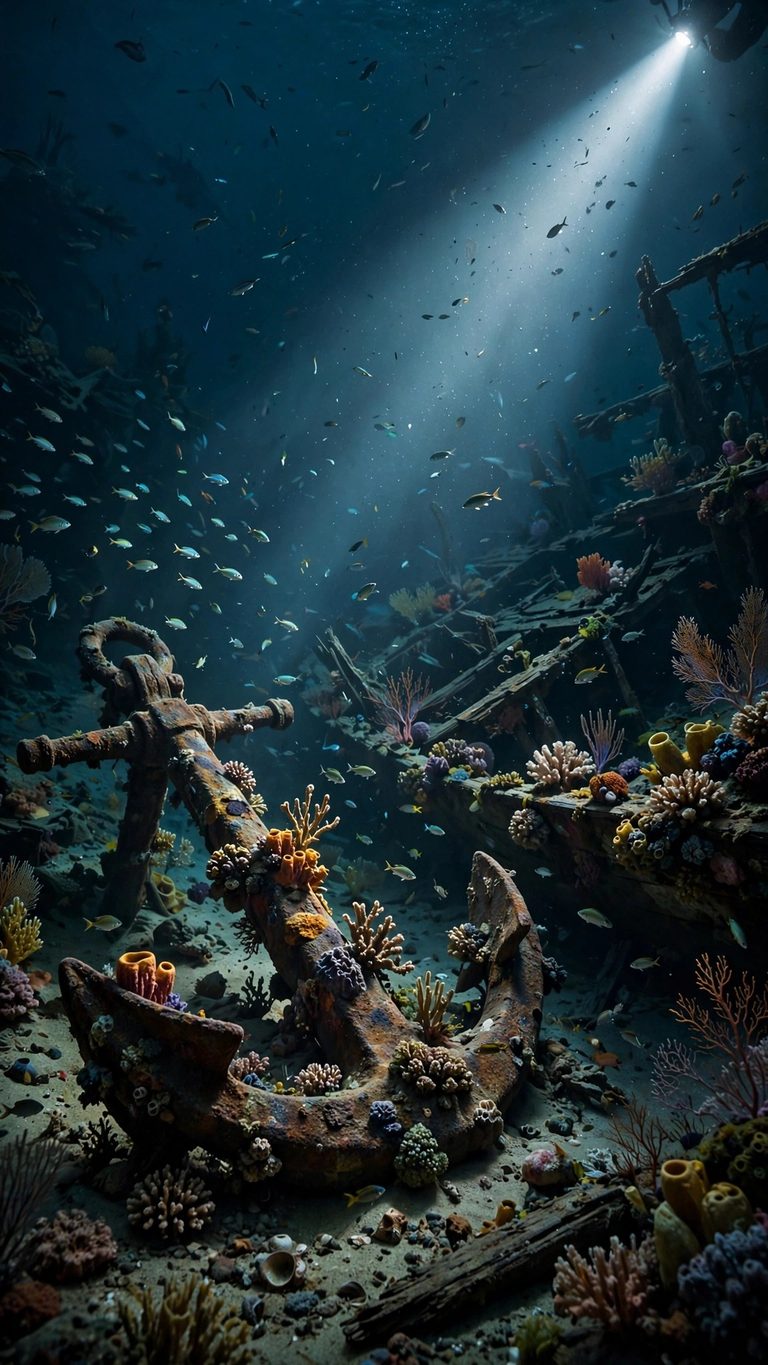
Every shipwreck is a time capsule — a moment of human history frozen on the seafloor, slowly being reclaimed by the ocean. A giant rusted anchor half-buried in sand, coral blooming across its iron flukes, a diver’s light beam cutting through the blue gloom: this is not just an underwater photo, it is a story about time, loss, and nature’s patient victory. Mystery is one of the most potent viral emotions on social media. Viewers cannot resist an unanswered question — what ship was this? When did it sink? What happened to its crew? — and that curiosity drives comments, shares, and saves as people tag friends to speculate together. That is why AI-generated ocean content goes viral: the ocean is the planet’s greatest keeper of secrets, and wreck imagery lets viewers play explorer from their couch. On Instagram, moody wreck photography in vertical 9:16 format stands out precisely because it is darker and more cinematic than the bright reef shots crowding the feed — contrast with the feed itself is an underrated virality lever. On Pinterest, shipwreck and “abandoned places” content has a devoted, high-saving audience that treats every pin as a new expedition. This prompt delivers lost history with a flashlight beam, and mystery does the rest.
The Prompt
Here is the exact prompt, ready to copy and paste into your favorite AI image generator. Every word was chosen to build mood, mystery, and cinematic wreck-diving atmosphere:
Moody photograph of a giant rusted anchor half-buried in sand beside a sunken shipwreck, coral and sponges growing over the iron, a diver's light beam cutting through blue gloom, small fish schooling around, lost history feel, ultra detailed, 8k, photorealistic, wreck photography
Why This Prompt Works
This prompt layers three storytelling devices that professional wreck photographers rely on: the relic, the light, and the life. “Giant rusted anchor half-buried in sand” is the relic — a single, recognizable human artifact that instantly communicates “shipwreck” without needing the whole ship. The anchor’s scale (“giant”) and decay (“rusted,” “half-buried”) do the narrative work: this thing has been here a long time, and time is inherently fascinating. “Coral and sponges growing over the iron” is the life — the visual proof of nature reclaiming human industry, a theme that resonates deeply with audiences drawn to “abandoned places” content. The contrast of orange rust against living coral also creates a rich, textured color story that rewards zooming in. “A diver’s light beam cutting through blue gloom” is the light — and it is the masterstroke. A visible light beam in dark water creates the strongest possible sense of exploration and presence; the viewer feels like the diver, discovering the wreck in real time. It also adds dramatic chiaroscuro that makes the image read as cinematic rather than documentary. “Small fish schooling around” adds scale and life, preventing the scene from feeling dead. Finally, “lost history feel” is an emotional direction that steers the model toward melancholy grandeur, while “ultra detailed, 8k, photorealistic, wreck photography” guarantees the rust texture, coral polyps, and particulate-filled light beam render with documentary-grade crispness. On Instagram, mystery-driven captions on wreck images generate comment threads of speculation — comments are gold for the algorithm. On Pinterest, the “abandoned” and “shipwreck” niches have intensely loyal savers.
How to Use This Prompt
Step one: copy the prompt exactly from the box above — keep “lost history feel” and the light-beam phrase intact, as they carry the mood and the composition’s focal point. Step two: paste into Midjourney, DALL-E 3, or Flux. In Midjourney, add –ar 9:16; the vertical frame suits the anchor’s upright flukes and the descending light beam. In DALL-E 3, select portrait orientation. Step three: generate four variations and evaluate them as a wreck diver would. The winning frame has the anchor clearly readable as an anchor (not a blob of rust), the light beam visibly cutting through the water with floating particles in it, and the coral growth colorful enough to contrast with the rust. Step four: upscale, paying attention to texture — rust pitting and coral detail are the stars here, so use an enhance mode that preserves grain rather than smoothing it. Step five: share it with a storyteller’s caption. On Instagram, lean into the mystery: “Somewhere in the deep, an anchor still waits for a ship that will never return.” Story captions on wreck images get saved and shared to stories. On Pinterest, keyword the title with “shipwreck photography,” “wreck diving,” and “abandoned underwater” to capture the dedicated explorer audience. Ten minutes, one prompt, and you own a piece of lost history.
Pro Tips & Creative Variations
Wreck imagery is a genre, and this prompt is your entry ticket — now build the filmography. Change the relic: swap “giant rusted anchor” for “a ship’s wheel encrusted with coral,” “a porthole glowing with trapped light,” “a brass bell on a tilted deck,” or “a diver’s helmet resting in the sand” — each artifact tells a different story and each deserves its own post. Change the time of day: “sunbeams piercing from the surface, illuminating the wreck in gold” trades gloom for glory, while “night dive, the wreck lit only by the diver’s torch” doubles down on the mystery for a darker aesthetic. Alter the camera angle with “diver swimming through the wreck’s broken hull, light beam ahead” for an interior exploration shot, or “aerial-style top-down view of the wreck’s outline in the sand” for a map-like, documentary feel. Shift the era and mood: “ancient wooden galleon wreck, cannons on the seafloor” for pirate romance, or “WWII submarine wreck, solemn and silent” for historical gravity. Change the life: “a sea turtle resting on the anchor,” “an octopus denning in the anchor’s curve,” or “a moray eel in the wreck’s shadows” adds a living co-star that broadens the audience. You can also serialize: “Wrecks of the Deep” — anchor, wheel, bell, hull — posted weekly, each ending with a question (“What do you think sank her?”) to drive comments. And cross-pollinate: borrow the whale shark’s diver-for-scale trick here — “a diver silhouetted against the anchor” — to make the relic’s size hit even harder.
Frequently Asked Questions
Q: The anchor looks like an unrecognizable rust blob. How do I fix it?
A: Anchors are hard for models. Add structural anchors (pun intended): “classic admiralty anchor shape, distinct flukes and shank, recognizable silhouette.” If it still fails, simplify to “large ship’s anchor” and let the model use its strongest prior.
Q: How do I get a realistic light beam in the water?
A: The phrase “diver’s light beam cutting through blue gloom” usually works, but you can strengthen it with “volumetric light rays, visible floating particles in the beam.” Volumetric is the keyword renderers understand for light-through-medium.
Q: Is it okay to present AI wreck images without labeling them as AI?
A: Best practice is transparency, especially for “photography” that implies a real dive. A simple “#AIGenerated” in the hashtags or a line in the caption keeps you honest without hurting performance — audiences accept AI art when it is not deceptive.
Q: Which platform performs best for wreck content?
A: Instagram for the cinematic mood and comment-driven mystery, Pinterest for the evergreen “abandoned places” search traffic, and YouTube Shorts if you animate it — a slow zoom on a wreck image with ambient audio is a proven Shorts format.
History does not always live in museums — sometimes it sleeps in the sand, rusting quietly, waiting for a light beam to find it. This prompt is that light beam. Generate the wreck, tell its story, and let your audience do what humans have always done with mysteries: wonder, together.
Related Viral Prompts
- Manta Ray Silhouette AI Photo Prompt: Dramatic Black Wings Against the Sun for Viral Underwater Wallpapers
- Seahorse Macro AI Photo Prompt: Exquisite Tiny Dragon Close-Up Shots for Viral Underwater Photography
- Underwater Waterfall AI Photo Prompt: Mauritius Optical Illusion Aerial Shot That Breaks the Internet
# A I P h o t o # P r o m p t B a z a r # S h i p w r e c k # A n c h o r # W r e c k D i v e

Leave a Reply