
Introduction
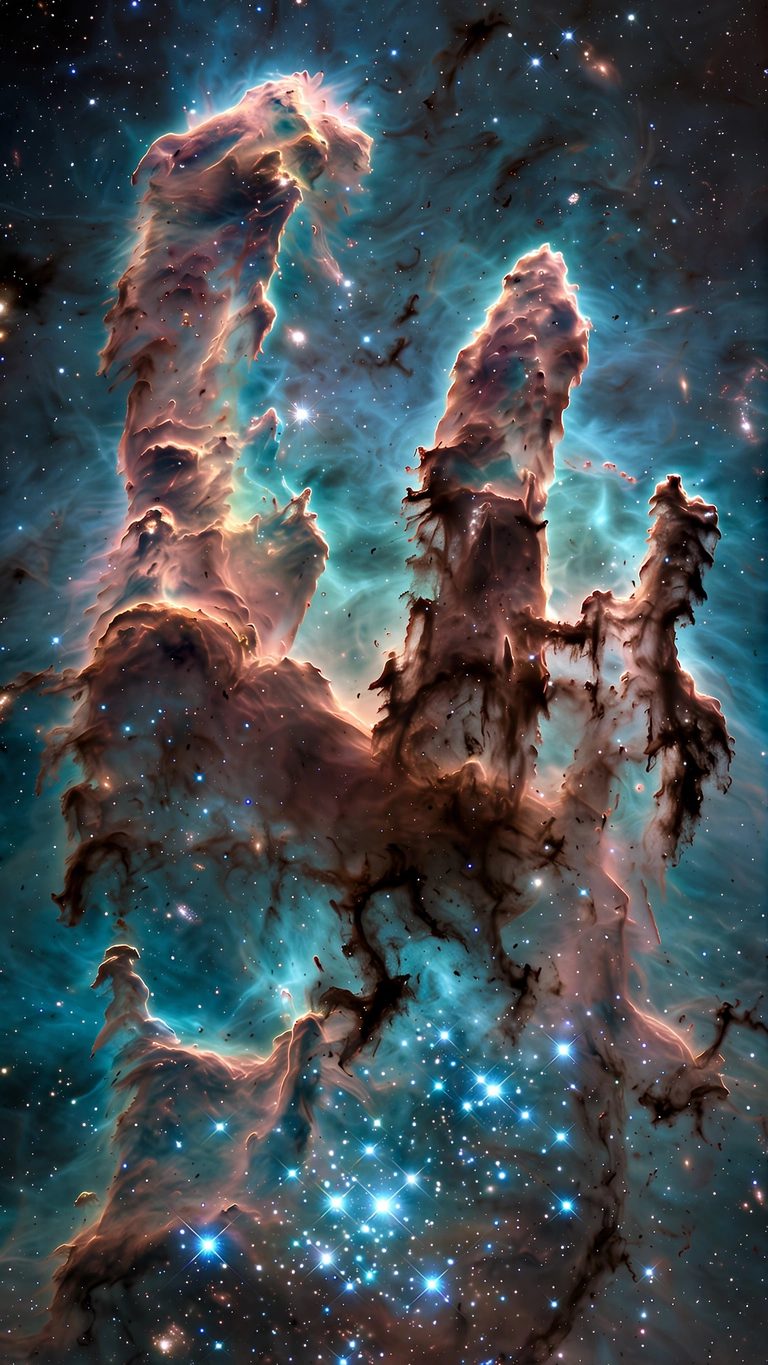
Some images rewired humanity’s sense of wonder. When the Hubble Space Telescope turned its gaze on the Carina Nebula, it returned pillars of glowing gas taller than entire solar systems, dust lanes blacker than midnight, and clusters of newborn stars burning blue-white against the dark. Those images became posters, textbook covers, and the desktop backgrounds of a generation — proof that the universe is not only vast but extravagantly beautiful. This AI photo prompt lets you create your own Hubble-style masterpiece: the Carina Nebula rendered in towering rose, gold, and teal, with dark dust carving through the light and brilliant young star clusters scattered like diamonds. It is deep-space art at its most majestic, the kind of image that works as a phone wallpaper, a framed print, or the visual anchor of any space-themed project. No telescope time required, no waiting for a servicing mission — just a prompt, a generator, and a few seconds. Below is the exact copy-paste prompt, an analysis of why every visual choice works, and step-by-step instructions for Midjourney, DALL-E 3, and Flux.
The Prompt
Copy the block below exactly as written and paste it into your favorite AI image generator. Every phrase was tuned for rich Hubble-style color and infinite depth:
Stunning deep space photograph of the Carina Nebula, towering pillars of glowing gas in rose, gold and teal, dark dust lanes carving through the light, clusters of brilliant young stars, Hubble-style rich color and detail, infinite depth, ultra detailed, 8k, photorealistic, astrophotography
Why This Prompt Works
This prompt works because it speaks the visual language of Hubble fluently — and Hubble’s language is the one the entire world has learned to read as “real deep space.” The color triad of “rose, gold and teal” is the foundation. These three hues sit in a rich, harmonious relationship: warm rose and gold carry the glowing ionized gas, while teal provides the cool counterpoint of oxygen-rich regions and background depth. Naming the palette explicitly prevents the AI from defaulting to generic purple-blue nebula mush and instead produces the sophisticated, multi-temperature look of processed space-telescope imagery. The “towering pillars of glowing gas” give the composition its architecture. Pillars — like the famous Pillars of Creation — are vertical, monumental structures that create a powerful sense of scale; they turn a flat field of color into a three-dimensional landscape the viewer feels they could fly through. The “dark dust lanes carving through the light” are equally vital: darkness defines light. Those inky lanes provide the contrast that makes the glowing gas blaze, and they add the turbulent, eroded texture of real star-forming regions where radiation sculpts the clouds. Then come the “clusters of brilliant young stars” — sharp, sparkling points that do two jobs at once. They sell the physics (this is a stellar nursery, stars are being born here) and they provide the glittering detail that rewards close inspection and makes viewers zoom in. The phrase “Hubble-style rich color and detail” is the genre anchor: it tells the model exactly which aesthetic tradition to draw on — high dynamic range, saturated but believable color, exquisite fine structure — rather than fantasy art or sci-fi illustration. “Infinite depth” pushes the composition toward layered recession, with nearer pillars sharp and distant star fields fading into the dark, creating the vertigo of true cosmic scale. Closing with “ultra detailed, 8k, photorealistic, astrophotography” locks in the documentary-grade finish. The shareability is proven by history: Hubble images are among the most-shared science images ever made, and this prompt lets anyone mint new ones in that beloved tradition.
How to Use This Prompt
Follow these numbered steps to render your own Carina Nebula on any major AI image platform:
- Copy the prompt. Highlight the full text in the box above, from “Stunning deep space photograph” through “astrophotography,” and copy it.
- Open your image tool. In Midjourney, type /imagine, paste the prompt, and add –ar 9:16 for a towering portrait of the pillars. In DALL-E 3, paste into ChatGPT or Bing Image Creator and request portrait orientation. In Flux, paste and set 9:16.
- Generate four to five variations. Nebulae vary enormously run to run. Keep the render with the most defined pillars, the richest rose-gold-teal balance, and the sharpest star clusters; discard any that look like blurry smoke.
- Upscale and download. Nebula detail is fine-grained — upscale to maximum resolution so the dust lanes and star points stay crisp, then save as PNG.
- Share or print. This is gallery-grade wall art. Post it, wallpaper it, or print it large — nebula prints are perennial bestsellers in space-art shops.
Pro Tips & Creative Variations
The Carina is your gateway; the whole deep-sky catalog awaits. Swap the subject while keeping the structure: replace “Carina Nebula” with “Orion Nebula,” “Eagle Nebula,” or “Horsehead Nebula” for instant new renders in the same majestic style — the pillar-and-dust-lane language transfers beautifully. Palette experiments are deeply rewarding: try “Hubble palette, sulfur gold, hydrogen red, oxygen teal” for the classic narrowband look, or “cool blue and violet monochrome, silver star points” for an elegant, moonlit variant. For a dramatic crop, add “extreme close-up of a single glowing pillar, dark space around” — isolating one structure creates an abstract, fine-art composition that looks stunning as a large print. Want a human element? Append “tiny silhouette of a distant spacecraft in the lower corner for scale” — the contrast between the machine and the cosmic architecture is profoundly humbling. Aspect ratio unlocks new lives for the image: 16:9 makes a breathtaking desktop wallpaper or video background, while 1:1 suits album covers and profile art. If your renders feel too smooth, add “fine filamentary structure, wispy tendrils of gas, mottled texture” to push the model toward Hubble’s famously intricate detail. A common failure is the “cotton candy” look — overly soft, formless clouds. Counter it with stronger structure words: “sharp defined pillars, crisp dust lanes, high contrast.” For print projects, go big: nebulae are one of the few subjects that genuinely improve at 24 by 36 inches, where the star clusters resolve into individual points of light. Finally, consider a triptych series — Carina, Orion, and Eagle in matching palettes — for a cohesive gallery wall or a social media series that keeps followers coming back.
Frequently Asked Questions
Q: How is “Hubble-style” different from a real Hubble photo?
A> Real Hubble images are built from actual telescope data, often combining multiple exposures and wavelengths. “Hubble-style” tells the AI to mimic their aesthetic — rich color, high detail, deep blacks — without claiming the result is genuine telescope data. Always label AI space art as AI-generated when sharing.
Q: Which AI tool renders nebulae best?
A> Midjourney is famous for lush, painterly nebulae with gorgeous color; Flux delivers sharper, more photographic detail; DALL-E 3 sits in between with clean, balanced renders. Run this prompt on at least two platforms and keep your favorite — the differences are striking.
Q: Can I print a nebula render at large sizes?
A> Yes — nebulae are ideal large-format subjects. Upscale to at least 150–300 DPI at your target size, and consider metallic or glossy paper, which makes the glowing gas appear luminous. Check your generator’s terms for commercial printing rights if you plan to sell.
Q: Can I animate this image into a video?
A> Absolutely. Feed your favorite still into an image-to-video tool and prompt a slow push-in through the pillars — the layered depth of a good nebula render translates into a mesmerizing parallax flythrough.
Stars are born in clouds of fire and dust, and Hubble taught us to see it. With this prompt, that vision is yours to create — copy it, render your nebula, and hang a stellar nursery on your wall.
Related Viral Prompts
- Galaxy Collision Zoom AI Video Prompt: Create a Mind-Bending Deep Space Cinematic That Stops the Scroll
- Astronaut Spacewalk AI Video Prompt: Experience a Breathtaking First-Person Spacewalk Above Earth for Free
- Black Hole Accretion Disk AI Video Prompt: Take a Hypnotic Orbit Around a Supermassive Black Hole in 8K
# A I P h o t o # P r o m p t B a z a r # N e b u l a # D e e p S p a c e # H u b b l e

Leave a Reply