
Introduction
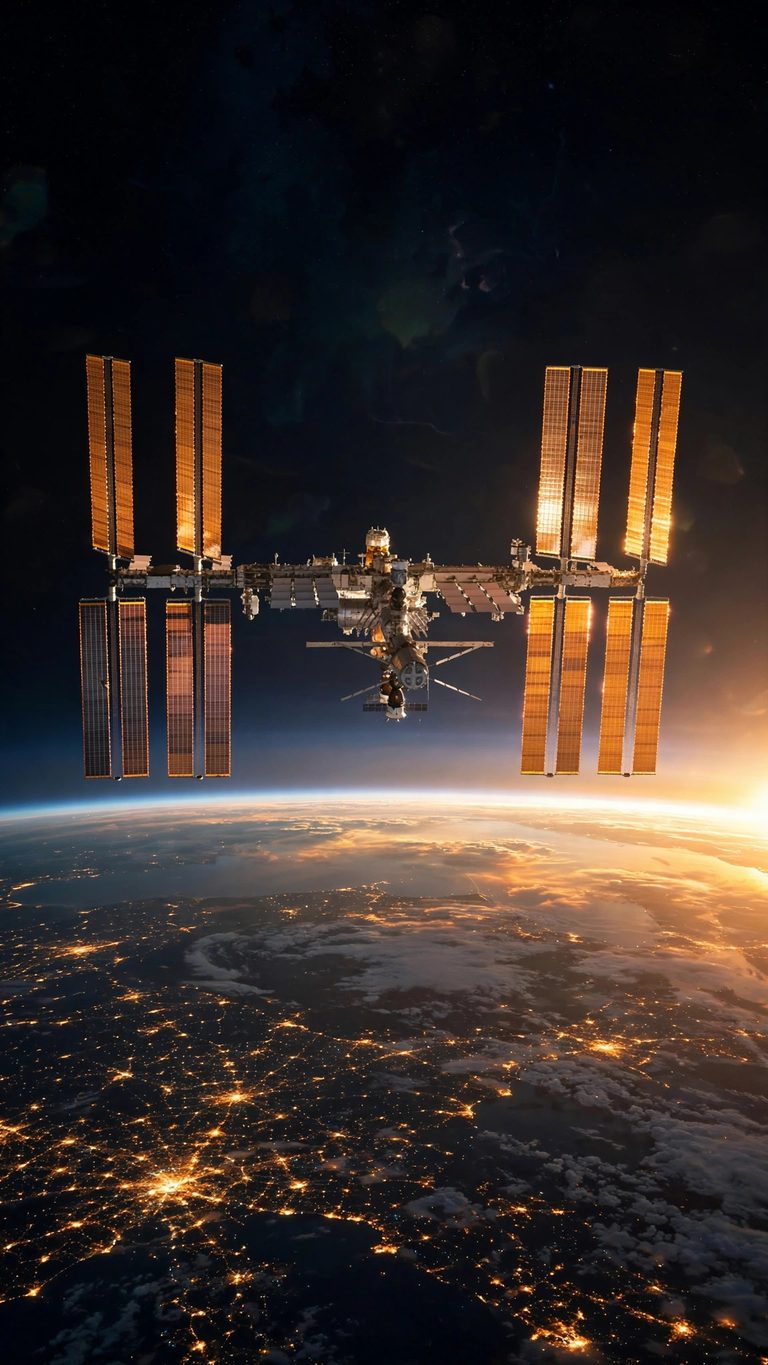
Two hundred and fifty miles above your head, right now, a structure the size of a football field is falling around the Earth at seventeen thousand miles per hour — and it has been doing so, continuously, for more than two decades. The International Space Station is humanity’s farthest permanent address, and the Space Station Sunrise Orbit AI video prompt captures its most beautiful moment: the station gliding over a sleeping Earth as the sun rises, solar panels catching fire-gold light, city lights fading on the night side below, the camera tracking alongside in perfect, weightless formation. There is no explosion here, no alien menace, no cosmic violence — just the quiet, staggering fact of human achievement hanging in the dark. And that is precisely why it works. In a feed engineered for outrage and shock, serene grandeur is a pattern interrupt; it makes people stop because nothing else looks like it. Sunrise-over-Earth footage is among the most rewatched content in the space genre because it delivers hope without preaching and awe without fear. This article gives you the exact prompt, dissects the cinematography that makes it majestic, and walks you through producing and publishing it on Veo 3, Runway, Kling, Pika, or Sora.
The Prompt
Copy the prompt below exactly as written and paste it into your favorite AI video generator:
Majestic shot of the International Space Station gliding over Earth as the sun rises, solar panels catching fire-gold light, city lights fading below on the night side, camera tracking alongside the station, peaceful and grand, ultra realistic, cinematic, 8k
Why This Prompt Works
This prompt works because it films pride. The International Space Station is not just a machine; it is the single most visible proof that rival nations can build something together in the most hostile environment imaginable, and audiences feel that whether or not they can articulate it. “Majestic shot of the International Space Station gliding over Earth” frames the station the way cinema frames heroes — in motion, in golden light, from a respectful distance — and the tracking camera (“camera tracking alongside the station”) makes the viewer a companion rather than a spectator. You are not watching the ISS; you are flying with it. That companionship is the emotional engine of the clip, and it is why ISS content earns some of the warmest comment sections on the internet: gratitude, wonder, and a surprising amount of patriotism-for-the-species.
The prompt’s lighting design is doing the rest of the work. “As the sun rises” plus “solar panels catching fire-gold light” stages the single most flattering light in photography — golden hour — on the single most photogenic machine ever built. Golden light on metallic panels creates rim highlights, lens-flare-adjacent glows, and long shadows that give the station sculptural depth; flat daylight would render it as a grey tangle, but sunrise renders it as a cathedral. Below, “city lights fading on the night side” adds the terminator line — the visible boundary between day and night sweeping across the planet — which is quietly the most mesmerizing element in all of orbital footage. It gives the scene motion at planetary scale and a built-in narrative: the world waking up. “Peaceful and grand” sets the emotional grade, steering the model away from action-movie drama and toward the reverent tone that makes this content endlessly rewatchable. Finally, “ultra realistic, cinematic, 8k” ensures the station’s intricate truss structure renders with the crisp detail that space enthusiasts scrutinize frame by frame. Get the solar panels right and the community trusts you; get them wrong and the comments will tell you.
How to Use This Prompt
Follow these steps to turn the prompt into a finished vertical video, ready for Reels, Shorts, and TikTok:
- Choose your generator. Open Veo 3, Runway Gen-4, Kling 2.x, Pika 2.x, or Sora. Veo 3 and Sora render the most accurate ISS structure; Kling’s motion smoothing is ideal for the gentle tracking shot.
- Paste the prompt exactly. Copy the full text from the
block above into the text-to-video field. Keep "solar panels catching fire-gold light" word for word — it is the lighting instruction that makes the shot.
- Set 9:16 vertical. Vertical framing lets you stack the station in the upper third, the sunrise band across the middle, and the curving Earth below — a natural cinematic composition.
- Set the duration. Generate an 8-second clip matching the prompt's tracking glide. The motion should feel effortless; if the camera jerks, regenerate rather than stabilizing in post.
- Generate and inspect the station. Run three to four generations and examine the ISS closely: solar panel geometry, truss structure, and modules should read as engineered, not melted. Space fans notice errors instantly, so be ruthless in selection.
- Add serene audio. A soft piano motif, gentle strings, or ambient pads work best. The audio should feel like dawn — quiet arrival, not fanfare. Avoid epic trailer music; it fights the "peaceful" grade.
- Caption with perspective. Try: "Good morning from 400 km up. 16 sunrises a day, every day, for 25 years." Hashtags: #iss #spacestation #sunrise #earth #aivideo. Post to Reels, Shorts, and TikTok in one session.
Pro Tips & Creative Variations
The terminator line — that glowing boundary between night and day — is your most powerful compositional tool, so learn to direct it. In remixes, specify its position: "terminator line sweeping across the Atlantic" versus "terminator over the Pacific at dawn" produce noticeably different moods, and naming real geography in your caption ("watch the sunrise hit the Himalayas") gives viewers a personal landmark to look for, which dramatically increases watch time. Your second lever is the station's orientation: "station silhouetted against the rising sun" creates a bold, graphic, almost spiritual image, while "close tracking along the solar panel array" turns the clip into an engineering appreciation post that performs well with tech audiences. Both come from the same prompt DNA.
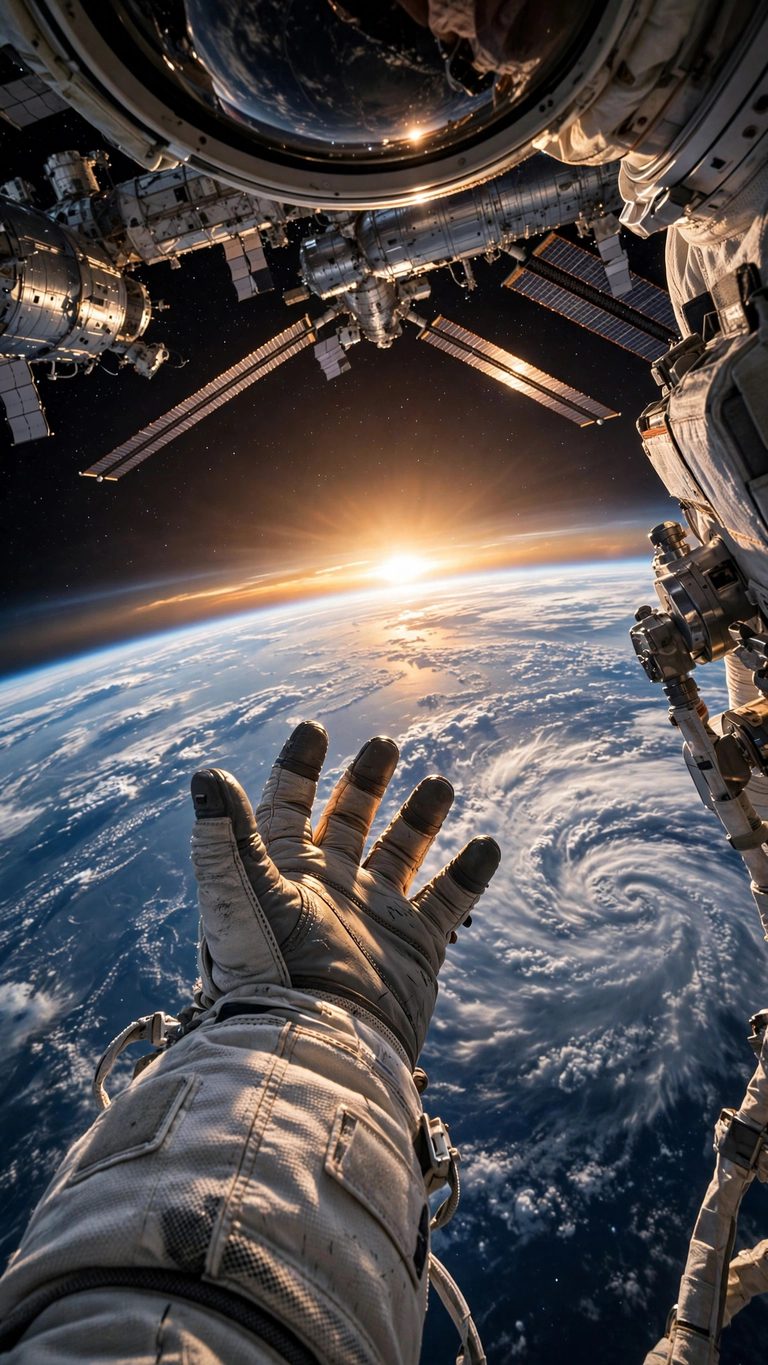
For series potential, build the "24 hours on the ISS" concept: sunrise, midday glare, sunset, and night-side city lights, four clips posted across one day with timestamps. The format is simple, the payoff is a full orbital day in your feed, and the final night-side clip — Earth glittering with city lights — is traditionally the highest-performing of the set. Another strong variation is the crew perspective: "view from inside the Cupola window as the sunrise floods in" flips the camera from outside the station to inside it, trading grandeur for intimacy, and Cupola content has a devoted audience of its own. You can also add the human fact layer that makes ISS content so shareable: text overlays like "The ISS travels 5 miles every second" or "Astronauts aboard are weightless right now" convert passive awe into active amazement. Finally, try the reflection cut — a version graded cooler and bluer, captioned for evening posting ("goodnight from orbit"). The same prompt, two color grades, two dayparts: morning hope and evening calm, doubling your content from a single idea.
Frequently Asked Questions
Q: How do I make sure the ISS looks accurate and not like a random sci-fi ship?
A: The prompt's "International Space Station" naming plus "ultra realistic" gets you most of the way, but always inspect generations for the signature features: the long truss backbone, the paired solar array wings, and the cluster of cylindrical modules. If the model invents a generic spaceship, append "accurate ISS configuration: truss structure with solar panel arrays" to your remix. Space enthusiasts are detail hawks — accuracy earns their shares.
Q: What is the best time to post sunrise-from-space content?
A: Match the content to the moment: post sunrise clips in the morning (6–9 AM audience local time) when people are waking up and the theme resonates, and save night-side Earth clips for the evening. Thematic timing sounds trivial, but it consistently lifts engagement because the video mirrors the viewer's own day.
Q: Can I combine this with real NASA footage?
A: Yes — NASA imagery is generally public domain, which makes it ideal for hybrid content. A popular format is opening with your AI tracking shot and cutting to real ISS sunrise timelapse footage from NASA archives, captioned "AI visualization vs. the real thing." The comparison format performs well and the real footage lends your AI work credibility by association.
Q: The camera motion feels robotic. How do I get a more natural tracking shot?
A: Use a generator with camera-motion controls (Runway's motion brush or Kling's camera settings) and set the tracking speed very low — orbital motion is stately, not swift. In post, add an almost imperceptible slow push-in (2–3% scale over the clip) to create parallax between the station and Earth, which sells the three-dimensionality far better than a perfectly locked camera.
The space station has circled our planet more than 150,000 times, carrying the quiet proof that we can build cathedrals in the sky. This prompt bottles one sunrise from that endless orbit. Copy it, render it golden, and post it. Some videos impress; this one uplifts.
Related Viral Prompts
- Nebula Flythrough AI Video Prompt: Soar Through a Dreamlike Pink, Teal & Gold Cosmic Storm Free Viral Clip
- Moon Footprints Earthrise AI Video Prompt: Recreate the Iconic Lunar Moment That Made History for Free
- Solar Flare Eruption AI Video Prompt: Capture Raw Stellar Power in a Blinding 8K Close-Up for Free Viral
# A I V i d e o # P r o m p t B a z a r # I S S # S p a c e S t a t i o n # S u n r i s e

Leave a Reply