
Introduction
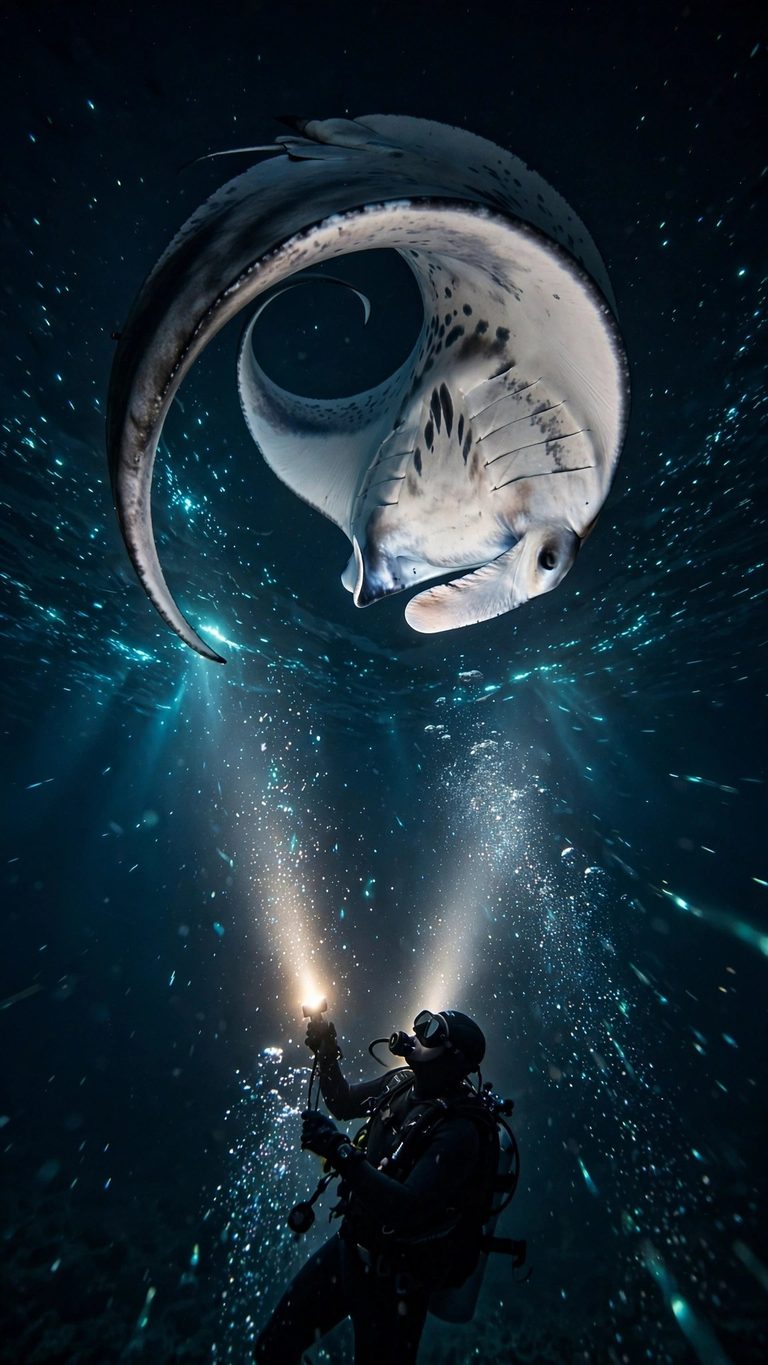
Night changes the ocean completely. The familiar blue world goes black, and then, in the beams of a diver’s lights, it ignites: plankton flares like underwater snow, and out of the darkness glides a manta ray, wings spanning wider than a car, moving with the slow grace of something that has never hurried in its life. It is the closest thing on Earth to watching a bird fly underwater, and it is mesmerizing. Night-dive footage has always been rare and precious because so few people ever witness it. AI-generated night dives change that equation entirely, and this prompt is the definitive manta ray version.
The scene is exquisitely composed: a giant manta soaring over a diver’s lights, plankton glowing in the beams, the ray looping through a slow barrel roll while the camera tracks beneath it. Every element serves the fantasy of being there in the dark water, weightless, watching something majestic unfold in artificial light. AI-generated ocean content goes viral when it offers viewers an experience they cannot easily have themselves, and a night dive with a manta ray is near the top of that list. Across Facebook Reels, TikTok, and YouTube Shorts, mysterious night-ocean clips earn exceptional watch time because darkness creates suspense: what will emerge from the black next? Below is the exact prompt, why each phrase works, how to generate it flawlessly, and variations that build a whole nocturnal ocean universe.
The Prompt
Copy the prompt below exactly as it is written. Every adjective and camera direction was chosen deliberately to steer the AI generator toward a cinematic, photoreal result, so paste it verbatim for the most reliable outcome.
Graceful night dive scene with a giant manta ray soaring over a diver's lights, its huge wings rippling, plankton glowing in the beams, the ray looping in a slow barrel roll, camera tracking beneath it, majestic and serene, ultra realistic, cinematic, 8k
Why This Prompt Works
The prompt’s genius is its lighting design. “Night dive” plus “a diver’s lights” solves the hardest problem in dark-scene generation: motivation for the light. AI models render night scenes far more convincingly when the prompt explains where illumination comes from, and dive lights create natural volumetric beams, glowing plankton, and dramatic falloff into blackness. “Plankton glowing in the beams” is the detail that sells the entire illusion: those drifting bright motes are exactly what real night-dive footage looks like, and viewers who have dived instantly recognize the authenticity.
Scale and motion do the emotional work. “Giant manta ray” with “huge wings rippling” establishes an animal of breathtaking size moving with impossible grace; the wing-ripple detail is critical because it is the manta’s signature movement, the slow underwater flight that distinguishes it from every other ray. “Looping in a slow barrel roll” is the showpiece maneuver, a real manta behavior performed at cleaning stations and in feeding spirals, and it gives the eight-second clip a clear beginning, middle, and end: approach, roll, glide away. Narrative arc inside a loop is retention gold.
“Camera tracking beneath it” chooses the single most majestic angle: looking up at the manta’s white belly patterned against the light, wings spanning the full vertical frame. In 9:16 this composition is towering and cathedral-like. “Majestic and serene” sets the emotional register precisely, steering the model away from horror-movie darkness toward wonder. The diver’s presence adds human scale, making the ray’s size legible and giving viewers a proxy: that tiny lit figure could be you. On platforms, night-ocean content benefits from the curiosity gap: the thumbnail is dark and mysterious, the reveal is glorious, and the loop replays the emergence, which is why these clips get watched multiple times and saved for late-night viewing.
How to Use This Prompt
Turning this prompt into a finished vertical video takes less than ten minutes. Follow these steps exactly.
Step 1: Pick your generator. Paste the prompt into any leading text-to-video model: Google Veo 3, Runway, Kling, Pika, or OpenAI Sora. Veo 3 and Kling currently produce the most photorealistic underwater footage, Runway offers excellent motion control, Pika is the fastest for quick drafts, and Sora handles complex scenes well. Any of them can render this prompt beautifully.
Step 2: Paste the prompt verbatim. Open the text-to-video mode and paste the full prompt from the box above. Do not paraphrase it on your first generation; the wording has been tuned for realism, camera behavior, and mood.
Step 3: Set vertical format and duration. Choose a 9:16 vertical aspect ratio so the clip fills a phone screen on Reels, TikTok, and Shorts. Set the duration to 8 seconds, or the closest option your tool offers. If the tool has a slow-motion or camera-lock setting, enable it to match the prompt.
Step 4: Generate two or three variations. Generation usually takes one to three minutes. Create a few variants and pick the one with the cleanest anatomy and smoothest motion; AI video sometimes warps fins, eyes, or water physics, so a quick quality check matters.
Step 5: Download and post. Download the MP4, upload it to Facebook Reels, TikTok, or YouTube Shorts, add a short hook caption with the post hashtags, layer a subtle ambient or trending sound at low volume, and publish during peak evening hours. Reply to early comments to push the video into wider distribution.
Pro Tips & Creative Variations
The night dive is a world, not just a clip. Vary the light: try “bioluminescent plankton, no diver, the manta trailing glowing wake” for a pure fantasy variant, or “red dive lights” for the eerie deep-tech aesthetic real technical divers use. Vary the maneuver: swap the barrel roll for “the manta somersaulting backward through the light beam” or “two mantas circling each other in a slow spiral,” which doubles the spectacle.
Vary the camera: “camera mounted on the diver’s shoulder, first-person view” creates an immersive POV that performs brilliantly with “POV: night dive” captions; “wide shot, diver tiny in the corner, manta dominating the frame” maximizes the scale contrast. Vary the cast: a whale shark gliding through the same light beams is an even more staggering scale reveal, while a sea turtle or a school of trevally silvered by the lights offers gentler variants. Shift the mood: lean into mystery with “something enormous passes just beyond the light’s edge” for a suspense cut that drives comments full of theories.
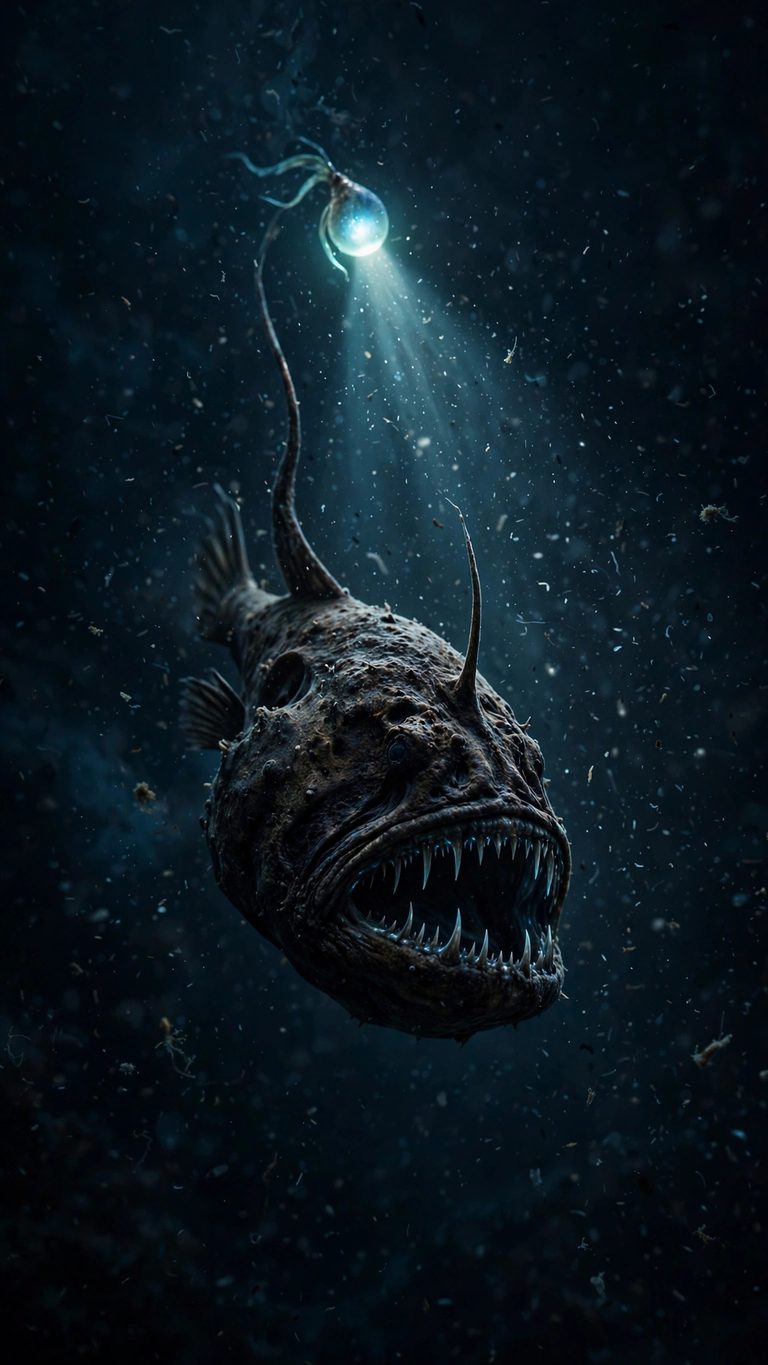
Build a “Night Ocean” series: manta Monday, bioluminescent bay Tuesday, anglerfish Wednesday, each with a consistent dark-grade look so your page develops a recognizable nocturnal identity. Sound design should be hushed: deep ambient drones, slowed whale-like tones, or the muffled sound of regulator breathing for documentary realism. Keep on-screen text minimal and elegant; darkness plus a single poetic line outperforms busy captions here. Generate extra takes because AI sometimes over-darkens the frame: if the manta is lost in black, append “manta clearly illuminated by the dive lights” and regenerate.
Frequently Asked Questions
Q: How do I keep the scene dark but still visible?
A: The prompt already balances this with the diver’s lights as the motivation. If your output is too dark, add “manta ray clearly lit by bright dive lights against the dark water” and regenerate. Avoid asking for “brighter” alone, which can wash out the night mood into murky grey.
Q: The diver looks distorted. Does it matter?
A: Keep the diver small and silhouetted; at that scale, minor distortions are invisible. If the model keeps rendering a mangled close-up diver, add “diver small in frame, silhouetted” to push the figure into the background where it belongs.
Q: What audio fits a night manta clip?
A: Low ambient drones, ethereal pads, or cinematic tension beds work best. Real regulator breathing sounds add documentary authenticity for dive-savvy audiences. Avoid upbeat trending audios; they shatter the serene night mood that makes these clips special.
Q: Can night-ocean clips anchor a whole content series?
A: Yes, and the consistent dark aesthetic becomes your brand: viewers will recognize your videos in the feed before reading the name. Alternate species and light setups weekly, keep the grading consistent in editing, and use recurring series titles like “Night Ocean Ep. 7.”
A manta ray barrel-rolling through dive lights is eight seconds of pure underwater majesty, and this prompt renders it flawlessly. Generate your night dive, keep the grade dark and elegant, then expand into the full nocturnal series above. The black water hides endless wonders: keep revealing them.
Related Viral Prompts
- Octopus Camouflage AI Video Prompt: Mesmerizing Macro Color-Change Over a Vibrant Living Coral Reef World
- Whale Shark Gentle Giant AI Photo Prompt: Diver-Scale Underwater Portrait in Vertical 9:16 for Instagram Reels
- Clownfish Anemone AI Photo Prompt: Vibrant Reef Macro Photography in Vertical 9:16 Portrait for Pinterest
# A I V i d e o # P r o m p t B a z a r # M a n t a R a y # N i g h t D i v e # O c e a n

Leave a Reply