
Introduction
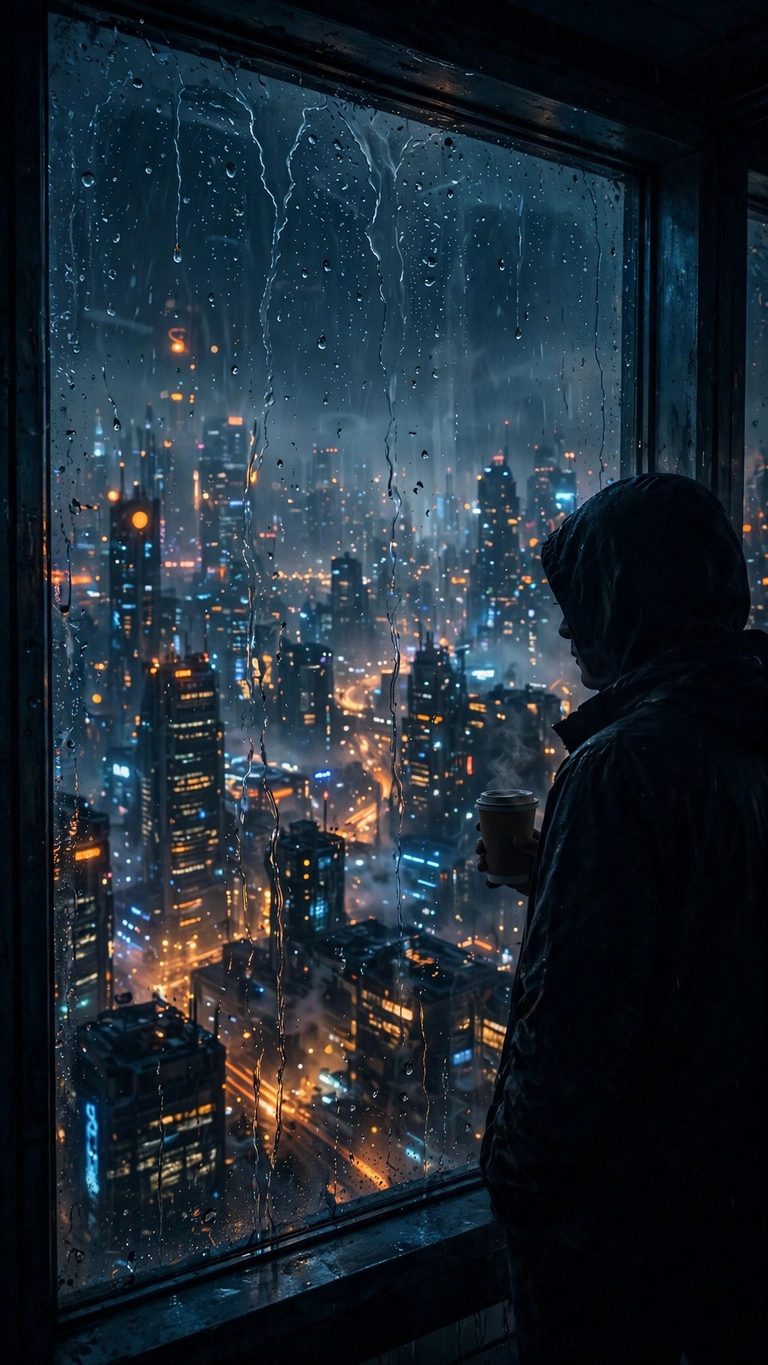
Some images are not looked at so much as felt. Press your forehead, in imagination, against the cold glass of a skyscraper window on a rainy night: on the other side of the streaked pane, an endless neon city glitters below in deep blues and lonely amber, each tower a small defiance of the dark. Your own faint reflection hovers in the glass — a silhouetted figure with a coffee gone cool — superimposed over the metropolis like a ghost the city hasn’t noticed. Raindrops warp and smear the lights into slow-moving constellations, and the whole frame holds its breath. This is cyberpunk’s quietest register: not the chase or the neon brawl, but the contemplative pause, the 2am inventory of a life. Melancholy is the genre’s secret superpower — it turns spectacle into emotion — and window-framed city views are its purest delivery system, because every viewer has stood at some window, somewhere, feeling exactly this. The #RainyWindow and #Moody aesthetic has a devoted following in the #AIPhoto world precisely because it doubles as emotional wallpaper: people save these images the way they save sad songs. This #Cyberpunk prompt from #PromptBazar composes that entire feeling — glass, rain, reflection, endless city — into one cinematic frame you can generate tonight.
The Prompt
Copy the prompt below in full. The layered composition — figure, glass, rain, city — is doing precise depth work, so keep every clause.
Melancholic cyberpunk photograph through a rain-streaked skyscraper window overlooking an endless neon city at night, a silhouetted figure with coffee reflected faintly in the glass, droplets distorting the glowing towers below, deep blues and lonely amber tones, quiet contemplative mood, cinematic composition, ultra detailed, 8k, masterpiece
Why This Prompt Works
This prompt is built on layers, and layers are what make an image feel cinematic. It constructs four planes of depth: the silhouetted figure in the foreground, the rain-streaked glass as a textural middle layer, the reflected coffee-cup ghost of the figure on the pane, and the endless neon city beyond. Image models render depth convincingly when each layer is named, and the result is a photograph with genuine dimensionality rather than a flat backdrop. The rain on the glass is doing double duty as both texture and lens: droplets distort the glowing towers into bokeh-like smears, which is a distortion models actually render well, and that softening is what makes the city feel vast and dreamlike instead of merely busy. Color psychology carries the emotion. Deep blues signal night, solitude, and introspection; the “lonely amber tones” cut through as warmth — windows lit from within, street-level life — so the palette itself tells the story of isolation observed from inside warmth. It is the visual equivalent of a minor chord with one hopeful note. The reflected figure with coffee is the narrative masterstroke: a reflection is inherently ghostly, suggesting presence and absence at once, and the coffee grounds the figure in a small, relatable ritual. Viewers do not just see a city; they see someone like them, awake too late, thinking too much — and identification is the strongest engagement trigger in visual media. That is why #Moody #Cyberpunk window shots accumulate saves at outsized rates: they function as emotional mirrors, and people collect mirrors. The “quiet contemplative mood” and “cinematic composition” clauses steer the model away from action-poster energy toward restraint, while “ultra detailed, 8k, masterpiece” ensures the rain texture — the soul of the image — renders with the fidelity it deserves.
How to Use This Prompt
Restraint rewards careful generation. In Midjourney v7, paste the prompt with --ar 9:16 for the portrait framing in the settings; the vertical format is ideal here, stacking figure, glass, and city in a natural viewing column. Add --style raw for a photographic rather than painterly feel. In DALL-E 3, request 9:16 portrait — DALL-E renders glass reflections and rain streaks with lovely subtlety, so generate three variants and choose the one where the figure’s reflection is faint but visible (too strong looks pasted-on; absent loses the story). In Flux, use a 9:16 canvas with guidance around 3.5–4.5; lower guidance preserves the soft melancholy, while high guidance can over-sharpen the rain into noise. Across all platforms, judge variants on the rain: the droplets should distort the city lights, not just sit on the glass like stickers. If the figure dominates, add “figure small in the frame, city dominant”; if the city overwhelms, reverse it. Slight desaturation in post — pulling vibrance down 10–15% — deepens the #Moody register beautifully. Upscale the winner; rain texture and bokeh bloom scale wonderfully. This is a natural phone wallpaper, story background, or the closing frame of a cinematic carousel.
Pro Tips & Creative Variations
The window is a frame within a frame — redecorate it. Change the weather: “snowflakes melting on the glass” turns the scene wintry and even quieter, while “a thunderstorm, lightning illuminating the city in flashes” electrifies the melancholy. Change the drink and the ritual: the coffee could be “a glass of whiskey catching the amber light,” “a steaming bowl of noodles,” or “a cigarette’s ember glowing in the reflection” — each a different short story. Change the figure: a silhouetted couple sharing the window becomes romance; a child with a forehead against the glass becomes innocence; an elderly figure becomes a lifetime of cities. Change the city: swap “endless neon city” for “a harbor of lit ships,” “a desert arcology glowing on the horizon,” or “the Earth seen from an orbital station window” — the window-and-rain formula ports to any vista. For visual variety, try “view from outside looking in, the figure framed by the lit window against the dark tower” — the same emotion, inverted. Add narrative props: “a cat asleep on the windowsill,” “a holographic photo flickering on the glass,” “unread messages glowing on a phone left on the sill.” Color remixes are potent here — “deep teals and rose gold” for a softer sadness, “monochrome blue with a single amber window” for stark minimalism. And for a series: the same window at 9pm, midnight, and 4am, the city dimming and the coffee cooling across the frames — a three-image short film about one long night that your #RainyWindow audience will feel in their chests.
Frequently Asked Questions
My reflection looks like a double-exposure mistake. How do I fix it? The model may render the reflection too opaque. Strengthen “reflected faintly” to “barely visible ghostly reflection” and regenerate. DALL-E 3 tends to handle subtle reflections most gracefully.
Can I remove the figure for a pure cityscape? Yes — drop the figure clause and the image becomes a rain-glass city study. But consider keeping at least a hint of reflection; the human trace is what separates this from a generic skyline render.
Why does my rain look like static noise? Over-sharpening. Lower the guidance scale (Flux) or add “soft bokeh rain, shallow depth of field” to push the droplets into creamy distortion rather than hard detail.
Is this style good for book covers or album art? Outstanding — moody window cityscapes are a staple of sci-fi covers and lo-fi album art. Generate at the highest resolution, check your platform’s commercial terms, and leave negative space if you plan to add typography.
Find your window. Paste the prompt, let the rain streak the glass, and watch the neon city smear into constellations below your reflection. When the melancholy lands just right, share it with #PromptBazar — the #Cyberpunk night is vast, and someone out there is awake at the same window.
Related Viral Prompts
- Neon Streets Rain Aerial AI Video Prompt: Create a Cinematic Cyberpunk City Flyover That Stops the Scroll
- Cyborg Portrait Close-Up AI Video Prompt: Generate a Hypnotic Neon-Lit Android Face That Watches You Back
- Flying Cars at Dusk AI Video Prompt: Build an Epic Cyberpunk Skyline Chase With Hundreds of Hover Vehicles
# A I P h o t o # P r o m p t B a z a r # C y b e r p u n k # R a i n y W i n d o w # M o o d y

Leave a Reply