
Introduction
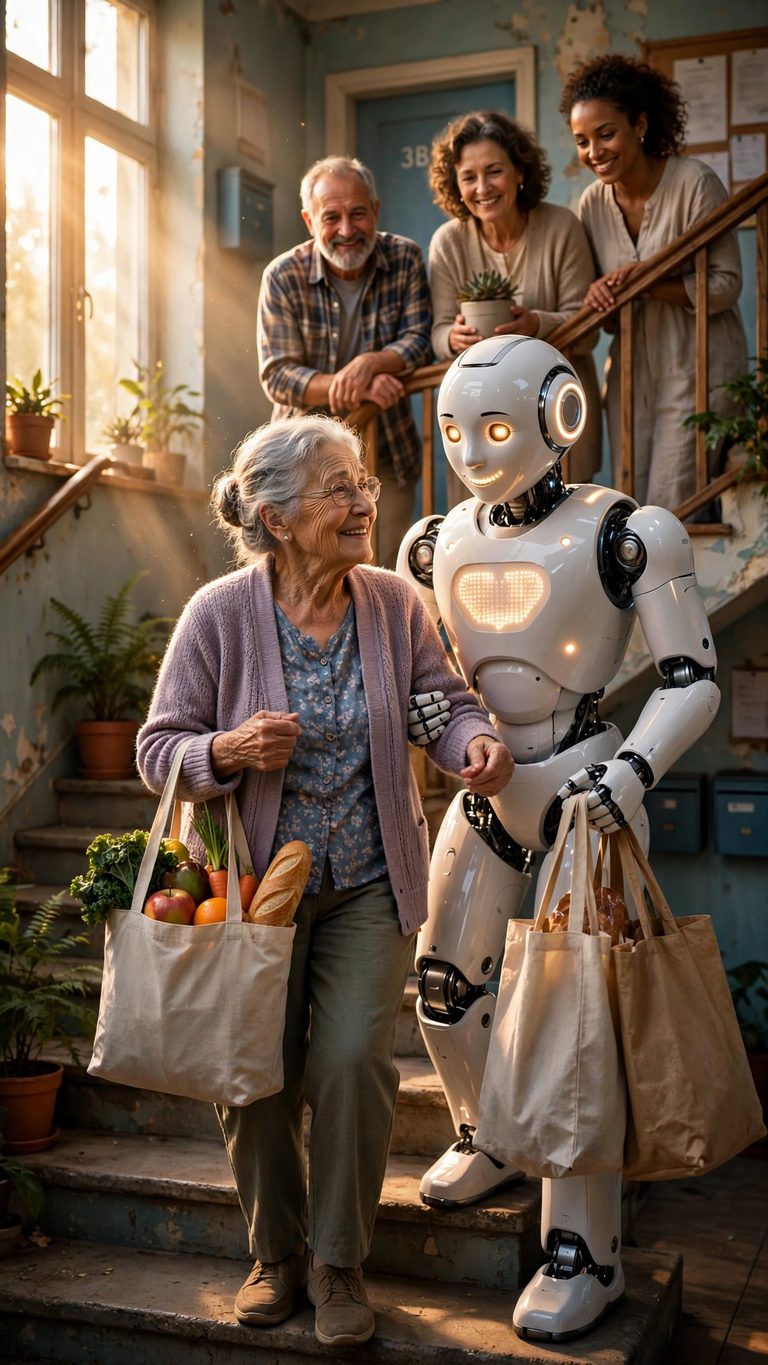
Every few weeks, a video appears on our feeds that does something remarkable: it stops the endless scroll and replaces cynicism with warmth. The latest wave of those videos has an unlikely hero — a robot. Not the cold, menacing machine of science fiction, but a gentle humanoid helper with kind glowing eyes, carrying grocery bags up a sunlit staircase for an elderly woman. It is the kind of eight-second clip that racks up millions of views, thousands of “faith in humanity restored” comments, and shares that travel from group chats to family threads within hours.
What makes this moment so powerful is the contrast. We have spent years being told to fear artificial intelligence, to picture robots as job-stealers and overlords. Then a single AI-generated clip flips the entire narrative in eight seconds: the machine is not taking something away, it is giving something back — dignity, care, and a helping hand to someone who needs it. The warm afternoon light streaming through the apartment windows, the neighbors watching with soft smiles, the smooth cinematic camera movement — every frame is engineered for emotion, and it works beautifully.
In 2026, heartwarming AI videos have become one of the most reliable viral formats on TikTok, Instagram Reels, and YouTube Shorts. Audiences are hungry for hopeful stories about technology, and creators who deliver them are building loyal followings fast. Below is the exact prompt behind one of the most shareable robot-kindness clips circulating right now, along with a complete breakdown of why it works and how you can recreate the magic yourself.
The Prompt
Copy the prompt below exactly as written and paste it into your favorite AI video generator. Every descriptive phrase was chosen to maximize emotional impact and photorealism.
Touching scene of a gentle humanoid robot helping an elderly woman carry grocery bags up sunny apartment stairs, robot smiling with kind LED eyes, warm afternoon light through windows, neighbors watching warmly, hopeful heartwarming mood, smooth camera movement, ultra realistic, 8k, cinematic
Why This Prompt Works
The psychology behind this prompt is a masterclass in emotional storytelling. First, it exploits the contrast effect: our brains are wired to notice when something defies expectations. A robot is supposed to be cold and mechanical, so when it performs an act of tenderness, the emotional impact is amplified far beyond what the same scene with a human helper would deliver. The “kind LED eyes” and the “smiling” robot are critical details — they personify the machine just enough to trigger our empathy circuits without tipping into the uncanny valley.
Second, the setting does enormous heavy lifting. Warm afternoon light is one of the most nostalgia-linked visual cues in cinema; it signals safety, home, and golden memories. The sunny apartment stairs feel familiar and intimate rather than futuristic and alien, which makes the scene relatable to viewers of every age. The elderly woman is a deliberate empathy anchor — across cultures, caring for elders is a near-universal value, so the video instantly earns moral approval from the audience before a single comment is typed.
Third, the prompt bakes social proof directly into the frame: “neighbors watching warmly.” When viewers see other people in the scene reacting with approval, it validates their own emotional response and models the behavior the creator wants — smiling, sharing, and commenting. On platforms, this translates into the holy trinity of virality: high watch completion (the scene resolves satisfyingly in eight seconds), emotional comments (“this is the future I want”), and shares to people the viewer loves. Hopeful AI narratives are also riding a massive trend wave in 2026, as audiences actively push back against doom-laden tech coverage by amplifying positive visions of the future.
How to Use This Prompt
Step 1: Choose your generator. For maximum photorealism, Veo 3 currently produces the most convincing human faces and warm lighting. Kling 2 excels at smooth character motion like climbing stairs, Runway gives you the finest camera control, Pika is perfect for quick test renders, and Sora handles cinematic lighting beautifully. Any of them can produce a strong result with this prompt.
Step 2: Paste the prompt verbatim. Do not paraphrase on your first attempt — the specific phrases “kind LED eyes,” “warm afternoon light,” and “hopeful heartwarming mood” are doing precise emotional work. Generate at 9:16 vertical aspect ratio and 8 seconds duration, which is the native format for Reels, Shorts, and TikTok.
Step 3: Generate two to three variants. AI video is probabilistic; the robot’s gait or the woman’s hand placement may glitch in one render and look perfect in the next. Keep the version with the smoothest stair-climbing motion and the most natural-looking LED eyes.
Step 4: Refine if needed. If the robot looks too stiff, add “gentle fluid movements” to the prompt. If the lighting feels flat, strengthen it with “golden hour glow.” Small targeted tweaks beat full rewrites.
Step 5: Finish for the feed. Add soft piano or acoustic background music, burn in a short caption like “The future is kind,” and include a one-line on-screen disclosure that the video is AI-generated. End with a gentle call to action in your caption asking viewers to tag someone with a kind heart.
Pro Tips & Creative Variations
The professional polish in the best versions of this clip comes from three details the prompt already hints at. Keep the robot’s expression unmistakably kind — soft glowing eyes, a slight head tilt toward the woman, unhurried movements. Harsh or blank machine faces kill the emotion instantly. Keep the stairwell light warm and directional, ideally raking across the scene from a side window; it sculpts both the robot’s form and the woman’s face in a way flat lighting never will. And do not skip the neighbors — even two background figures smiling in a doorway multiply the emotional payoff, because shared warmth feels more real than solitary warmth.
Once you have the base version, the variations are where a series — and a following — is born. Try a rainy-day version where the robot holds an umbrella over the woman as well as carrying her bags. Move the scene to a park bench where the robot helps her stand, or a grocery store aisle where it reaches a high shelf for her. Swap seasons: a robot brushing snow off her walkway is pure winter viral bait. You can also build a recurring character — name your robot, keep its design consistent across clips, and release a “Kindness Bot” episode every few days. Series content trains the algorithm and the audience alike: viewers follow for the next chapter, and completion rates climb because people already trust the payoff.
For extra production value, generate a matching thumbnail image with the same robot design, and consider a 3-second pre-hook version for testing: start the clip mid-action on the stairs rather than with a slow establishing move. Test both against each other; the data will tell you which opening your audience prefers.
Frequently Asked Questions
Q: Will viewers be upset when they learn the video is AI-generated?
A: Not if you are transparent. Add “AI-generated” to your caption or as a small on-screen label. Audiences in 2026 are remarkably accepting of synthetic feel-good content as long as nobody is being deceived — the emotion is real even when the pixels are not. Hiding the AI origin, on the other hand, can trigger backlash if the clip goes mega-viral.
Q: Which free tool gives the best result with this prompt?
A: Kling’s free tier and Pika both handle this scene well at no cost, with Kling having a slight edge on natural humanoid motion. If you can access a trial of Veo 3, use it for your hero version — the facial warmth on the elderly woman is noticeably better.
Q: Why is the prompt only eight seconds long? Should I make it longer?
A: Eight seconds is the sweet spot for this concept: long enough to establish the scene, show the kind act, and land the emotional beat, but short enough to guarantee near-total watch completion and instant replays. Replays are a powerful ranking signal. Start with eight seconds; only extend if you are building a multi-beat story.
Q: Can I monetize videos made with this prompt?
A: Yes, on most platforms, provided you follow each platform’s AI-content disclosure rules and the generator’s commercial-use terms. Kindness and wholesome content also attracts brand-safe advertisers, which makes this niche unusually friendly for creator monetization programs.
This prompt proves that the most viral technology stories are not about what machines can do — they are about what machines can make us feel. A robot, a staircase, and a simple act of kindness: that is all it takes to remind millions of people what the future could look like. Paste the prompt, render your version, and share a little warmth today. Tag someone kind, and watch what happens.
Related Viral Prompts
- Robot Artist AI Video Prompt: Watch a Machine Paint a Stunning Portrait That Stops the Scroll in 2026
- Epic AI Data Center Corridor AI Video Prompt: A Cinematic Glide Through the Heart of the Machine Age
- Humanoid Robot City Walk AI Video Prompt: The Candid Street Scene Everyone Cannot Stop Watching in 2026
# A I V i d e o # P r o m p t B a z a r # R o b o t # K i n d n e s s # H e a r t w a r m i n g



Leave a Reply