
Introduction
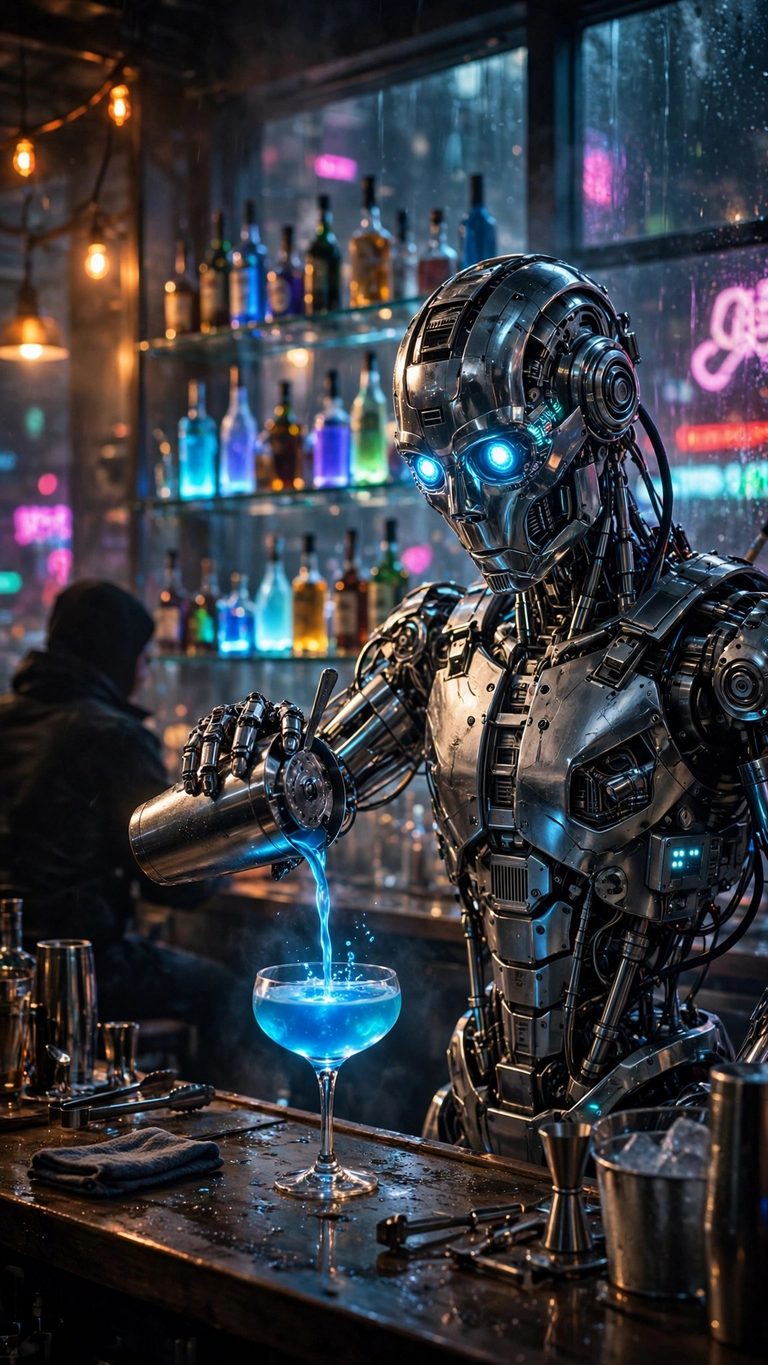
Push open the door of a future bar and the first thing you notice is not the music — it is the light. Behind the counter, a chrome robot bartender tilts a shaker with mechanical grace, its expressive LED eyes tracking you as it pours a cocktail that glows an impossible blue. Behind it, bottles of luminescent liquor line glass shelves like captured auroras, neon signs bleed their colors through rain-streaked windows, and at the far end of the bar a customer’s silhouette waits in the warm-cool crossfire of the lighting. This is cyberpunk at its most seductive: not the battlefield or the chase, but the watering hole where humans and machines share the same small rituals. The robot bartender is one of the genre’s most beloved figures because it asks the gentlest version of the big question — if a machine can mix your drink and read your mood, what exactly is left that is only human? That quiet philosophical charge, wrapped in chrome and neon, is why #Bartender and #Robot themed #AIPhoto renders travel so well: they are intimate, stylish, and instantly readable at thumbnail size. This #Cyberpunk prompt from #PromptBazar bottles that whole atmosphere — the glow, the glass, the rain outside — into a single close-up you can generate in under a minute.
The Prompt
Copy the prompt below exactly. The warm-and-cool light mixing is the detail that makes this render special, so keep every clause intact.
Stylish cyberpunk photograph of a chrome robot bartender with expressive LED eyes pouring a glowing blue cocktail, bottles of luminescent liquor on glass shelves behind, neon signs bleeding through rainy windows, a customer silhouette at the bar, warm and cool light mixing, intricate mechanical details, ultra detailed, 8k, masterpiece
Why This Prompt Works
This prompt succeeds because it stages a portrait with the discipline of a cinematographer. A “close-up” is an explicit framing instruction that tells the model where to spend its detail budget: on the chrome face, the LED eyes, the pouring cocktail — the elements that carry the image. The “intricate mechanical details” clause then reinforces that allocation, pushing the model toward crisp servos, seams, and reflections instead of a smooth mannequin face. Color theory is doing quiet work throughout. Warm and cool light mixing — amber bar light against blue cocktail glow and neon — is the single most flattering lighting setup in photography, and models reproduce it reliably because it appears in countless training images of bars and restaurants. The glowing blue cocktail is the focal anchor: a small, saturated light source at the center of the frame that the eye locks onto first, with the LED eyes providing a secondary catch-light that keeps the face alive. The background layers are composed like a film set — luminescent bottles on glass shelves (mid-ground texture), neon bleeding through rainy windows (depth and atmosphere), customer silhouette (narrative context) — each at a different depth, which gives the model a natural depth-of-field hierarchy to render. Psychologically, the scene hits the #Cyberpunk sweet spot between wonder and comfort: a robot that serves rather than hunts, in a setting every viewer understands. That approachability is why bartender renders earn comments, not just likes — people project themselves into the customer’s seat, and comment sections drive the algorithmic boost that #AIPhoto creators chase. The closing tokens “ultra detailed, 8k, masterpiece” steer the model into its high-fidelity mode, where chrome reflections and liquid glow get the extra sampling passes they need to look real.
How to Use This Prompt
Close-ups punish sloppy settings, so dial them in. In Midjourney v7, paste the prompt with --ar 9:16 for the portrait framing from the settings and consider --style raw to keep the chrome looking photographic rather than illustrated. If the face renders too smooth, add “weathered chrome, visible panel lines” to taste. In DALL-E 3, request 9:16 portrait; DALL-E renders glowing liquids and glass beautifully, so the cocktail and bottle shelves usually land on the first try — generate three variants and pick the one with the best LED eye expression. In Flux, use a 9:16 canvas with guidance around 4; Flux’s mechanical detail is superb, making it arguably the best choice for this particular prompt, especially for the robot’s hands and the shaker. Across all platforms, watch the hands — AI models still occasionally fumble fingers and grippers, so zoom into the pour in your chosen variant before posting. If the cocktail glow washes out the face, add “balanced exposure, face clearly lit.” Upscale the winner; the tiny highlights in the bottles and the rain on the window reward every extra pixel. This 9:16 portrait is tailor-made for stories, reels covers, and phone wallpapers.
Pro Tips & Creative Variations
The bar is a stage — redress it. Change the drink: a glowing blue cocktail can become a smoking violet absinthe, a golden synth-whiskey, or a layered rainbow shooter, each recoloring the key light and therefore the whole image. Change the robot’s character: “expressive LED eyes” can become “vintage CRT monitor face” for retro charm, “holographic face projection” for high-tech mystery, or add “art-deco brass plating” to turn the bartender into a 1920s automaton. Change the clientele: the customer silhouette could be an android couple on a date, a weary detective, or a crowd of regulars — each implies a different story. Push the atmosphere with “cigar smoke curling through the neon light” or “a jukebox glowing in the corner.” For a horror pivot, try “the bartender’s LED eyes flicker red for a frame, subtle menace” — small menace, big engagement. Camera moves matter: “over-the-shoulder view from the customer’s seat” makes the viewer the patron, while “extreme close-up of the pour, cocktail glowing” becomes pure product photography. Seasonal variants are easy wins — “snow falling outside the windows” for a winter edition, “heat shimmer” for a desert bar. And for series builders: keep the same robot and bar but change the drink and the hour across five renders to create “a night at the chrome bar,” a narrative sequence your #Cyberpunk audience will follow to the last pour.
Frequently Asked Questions
Why do the robot’s hands look wrong? Hands and grippers remain the hardest anatomy for image models. Generate multiple variants and pick the cleanest pour, or crop tighter on the face and shaker. Flux and Midjourney v7 have the best track record here.
Can I make the bartender female-presenting or stylized? Yes — add descriptors like “elegant feminine chrome design” or “retro-futuristic art-deco styling.” The prompt’s structure survives reskinning well because the lighting and composition clauses are independent of the character design.
How do I get a landscape version for a banner? Switch to 16:9 and add “wide shot of the full bar.” You will need to regenerate several times since the prompt was composed for a 9:16 close-up, but the background layering clauses adapt well to wider frames.
Will the neon text on the signs be gibberish? Possibly — models still struggle with legible signage. Either embrace the abstract glow or add “signs with no text, pure color glow” to avoid the uncanny misspelled-letter effect.
Last call at the chrome bar. Paste the prompt, frame it 9:16, and let the blue cocktail glow do the talking. When your robot bartender is pouring, share the render with #PromptBazar — the #Cyberpunk crowd is thirsty, and your bar is open.
Related Viral Prompts
- AR Street Overlay: A Mind-Bending Cyberpunk AI Photo Prompt for Augmented-Reality Future City Scenes
- Rainy Window City View: A Melancholic Cyberpunk AI Photo Prompt for Moody Neon Night Photography Art
- Neon Streets Rain Aerial AI Video Prompt: Create a Cinematic Cyberpunk City Flyover That Stops the Scroll
# A I P h o t o # P r o m p t B a z a r # C y b e r p u n k # B a r t e n d e r # R o b o t

Leave a Reply