
Introduction
Every few decades, a visitor arrives that no living human has seen before — and that no living human will see again. A comet is a mountain of ancient ice falling toward the Sun, and as it warms, it grows a tail of glowing dust millions of kilometers long: a lantern swinging through the dark, visible to the naked eye, indifferent to everything below it.
For most of history, comets were omens — harbingers of kings’ deaths and coming wars. Then science gave us a better story: these are time capsules from the birth of the solar system, older than Earth itself, and watching one is like receiving mail from 4.6 billion years ago.
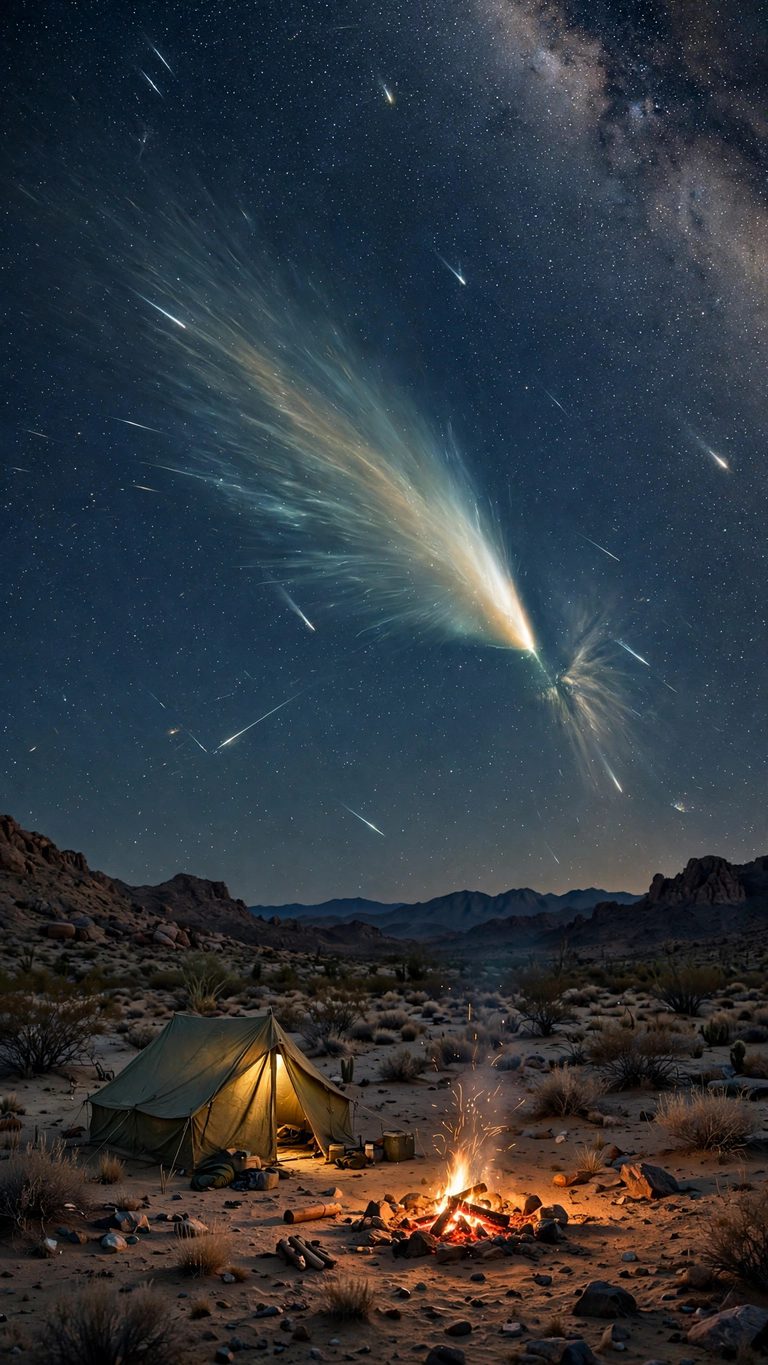
This AI video prompt captures that feeling in its purest form. A bright comet streaks across a star-filled desert sky, its tail fanning out, while below, a lone tent glows beside a campfire. Ten seconds, one slow pan, total magic. It is the rare space video with a human heartbeat in it — and that is exactly why it works.
The Prompt
Copy the prompt below exactly as written into your AI video generator. The tent and campfire may look like background detail, but they are the emotional core of the shot — do not remove them.
Stunning night shot of a bright comet streaking across a star-filled desert sky, its glowing tail fanning out, camera slowly panning to follow it, a lone tent and campfire below, shooting stars around, magical and timeless, ultra realistic, cinematic astrophotography, 8k
Why This Prompt Works
This prompt succeeds because it understands that cosmic awe needs a human anchor. “A lone tent and campfire below” is the most important phrase in the whole prompt — it gives the viewer a surrogate, a place to stand, a warm orange counterpoint to the cold blue vastness above. Without it, this is just another pretty sky. With it, it is a story: someone is out there, small and warm, watching eternity go by. Viewers project themselves into that tent instantly, and projection is what drives saves and shares.
The camera direction is equally smart: “camera slowly panning to follow it.” A slow pan that tracks the comet does two things — it keeps the brightest subject framed, and it makes the star field drift, which sells the reality of the shot. Static astrophotography looks like a photo; a tracking pan looks like someone was really there with a camera. That “I could have filmed this” quality is priceless for engagement, because it lowers the viewer’s skepticism and raises their wonder.
“Its glowing tail fanning out” gives the comet structure and motion — tails have texture, and the model will render streaming, feathered detail rather than a simple streak. “Shooting stars around” layers secondary motion so no part of the frame is dead; the eye always has somewhere to travel. And “cinematic astrophotography” is a precise style anchor: it tells the model to mimic long-exposure night-sky photography — sharp stars, rich blacks, natural color — rather than sci-fi illustration. “Magical and timeless” sets the emotional grade. The result feels less like AI and more like the best night you never had.
How to Use This Prompt
- Choose your generator. Veo 3 and Runway Gen-4 render night skies and firelight most naturally; Kling 2, Pika 2, and Sora handle this prompt well too.
- Set the format. Start a text-to-video project in 9:16 vertical with a 10-second duration.
- Paste the prompt exactly. Keep “a lone tent and campfire below” — it is the emotional core of the shot.
- Direct the pan. Confirm a slow pan in the direction of the comet’s travel. If your tool supports directional camera control, pan with the comet, not against it.
- Cherry-pick your take. Generate a few variations and pick the one with the sharpest stars and the most natural campfire glow.
- Finish and post. Add night-desert ambience — soft wind, distant crackling fire — for sound. Add a hook like “The visitor that returns once in a lifetime” and post to Reels, Shorts, and TikTok with #Comet, #NightSky, and #Astrophotography tags.
Pro Tips & Creative Variations
The desert-comet formula is endlessly remixable. Swap the celestial event: “a meteor shower raining over the desert camp” gives you dozens of streaks instead of one tail; “the Milky Way core rising behind the tent, timelapse” trades the comet for galactic grandeur; “northern lights rippling above a snowy camp” ports the whole concept to the Arctic. Each keeps the tent-and-fire anchor that makes the original work.
Swap the landscape too. A comet over ocean cliffs, over a mountain lake with perfect reflections, or over ancient ruins — “a comet above a stone temple, torchlight below” — each setting tells a different story with the same sky. Reflections are especially powerful: ask for “the comet reflected in still water” and you double the spectacle for free.
For craft, push the contrast the prompt implies: warm firelight against cool starlight is the whole color story, so in post, warm up the lower third and cool down the sky slightly. Add a human silhouette — “a lone figure silhouetted beside the campfire, looking up” — and engagement jumps, because faces and figures always outperform empty landscapes. Real-world timing helps: post comet content during actual comet apparitions or meteor showers (the Perseids every August are a guaranteed window). And consider brands: this aesthetic is catnip for camping, outdoor gear, and travel pages — a natural collaboration format.
Frequently Asked Questions
Q: Which tool renders the best starry night skies?
A: Veo 3 and Runway Gen-4 produce the sharpest, most natural star fields with the least warping. Kling 2 is strong on the campfire glow. Avoid over-sharpening in post — real astrophotography has a soft richness that heavy sharpening destroys.
Q: My comet’s tail looks fake and blobby. How do I improve it?
A: Strengthen the tail description: keep “glowing tail fanning out” and add “delicate streaming dust tail, feathered edges.” A negative prompt of “cartoon, blurry blob, solid shape” helps. The tail should look like light, not like an object.
Q: Should the camera pan with the comet or stay still?
A: Pan with it — the prompt’s “slowly panning to follow it” is correct. A static camera lets the comet exit the frame too fast; tracking keeps it composed and makes the background stars drift, which reads as professional camerawork. Keep the pan slow — fast pans break the timeless mood.
Q: Can I use this style for client work, like a travel brand?
A: Yes, with the usual caveat: check your AI tool’s commercial terms on your plan tier. This aesthetic — tent, fire, epic sky — is one of the most commercially versatile AI looks, used for outdoor brands, tourism boards, and festival promos. Keep your generation records for licensing clarity.
Comets do not care about us. They swing through on their ancient schedules, tails blazing, whether or not anyone looks up. But when someone does — from a tent, beside a fire, in the middle of nowhere — it becomes a story worth telling. Paste the prompt, light the fire, and let your audience watch the sky.
Related Viral Prompts
- Milky Way Desert AI Photo Prompt: Generate a Stunning Night Sky Astrophotography Masterpiece for Free
- Astronaut Helmet AI Photo Prompt: Create a Heroic Space Portrait With Planet Earth Reflected in the Visor
- Ringed Planet AI Photo Prompt: Generate a Majestic Gas Giant Planet With Beautiful Sunlit Icy Rings Free
# A I V i d e o # P r o m p t B a z a r # C o m e t # N i g h t S k y # D e s e r t

Leave a Reply