
Introduction
Every second, the Sun converts 600 million tons of hydrogen into light — and some mornings, it does it violently. A solar flare is a snap in the Sun’s magnetic field, a whip-crack of white-hot plasma that can arc higher than a dozen Earths stacked end to end, releasing the energy of a billion atomic bombs in minutes. If one of the big ones ever points at us, it could black out continents.
We will never stand on the Sun’s surface. No camera we build will ever get this close and survive. The Solar Dynamics Observatory gives us distant, filtered glimpses — spectacular, but always at arm’s length, always through instruments.
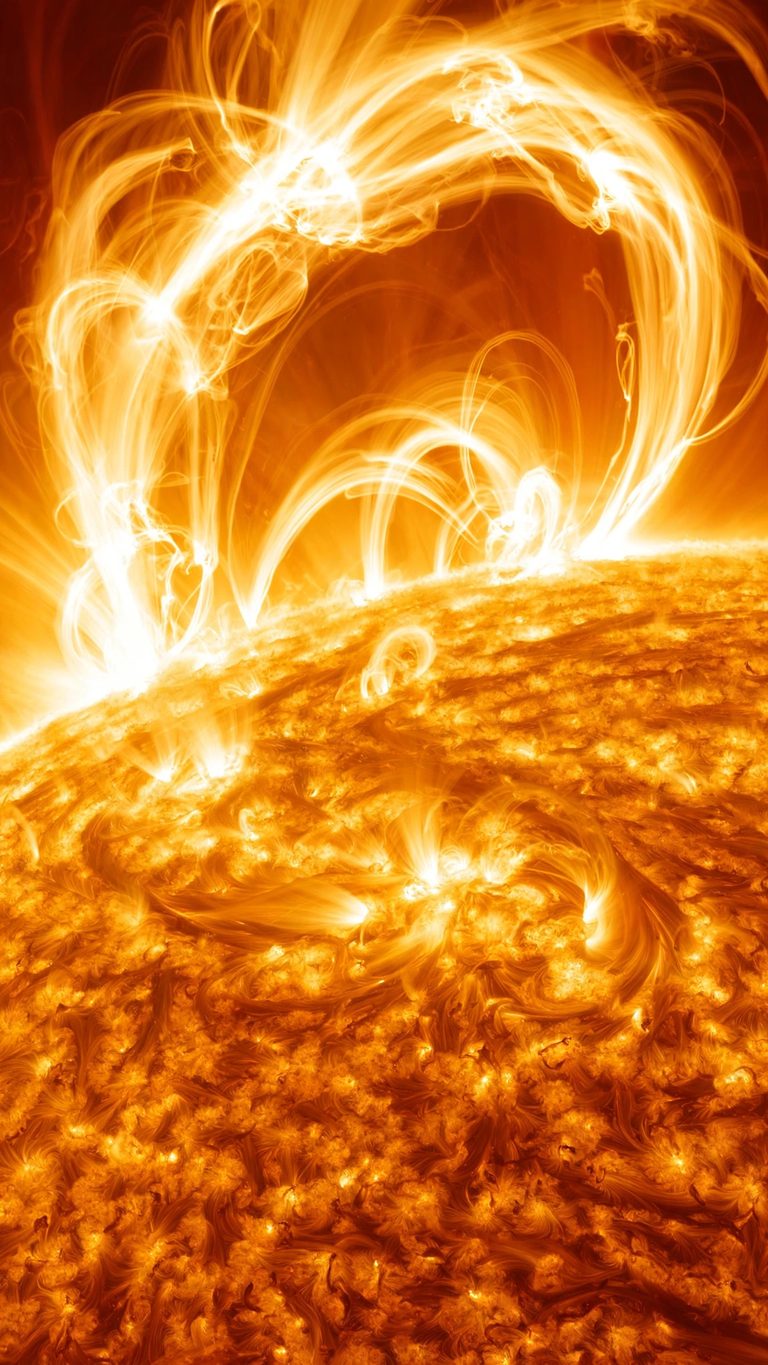
This AI video prompt closes that impossible distance. It plants a virtual camera on the boiling granulation of the photosphere and holds it steady while a massive flare loops outward in arcs of blinding plasma. Eight seconds of raw stellar power, in golds and oranges so intense they feel hot through the screen. It is the closest any human will ever get to standing inside a star — and viewers can feel the heat.
The Prompt
Copy the prompt below word for word into your AI video generator. The locked camera and the scientific texture words are what separate this from generic fire footage — do not paraphrase them.
Violent close-up of the sun's surface erupting, a massive solar flare looping outward in arcs of white-hot plasma, granulation boiling below, camera holding steady as the flare towers, raw stellar power, blinding golds and oranges, ultra realistic, cinematic, 8k
Why This Prompt Works
What makes this prompt exceptional is its discipline. Most AI space prompts ask for sweeping camera moves; this one says “camera holding steady.” That locked close-up is a power move. When the camera does not move, all the motion belongs to the subject — the boiling granulation, the towering plasma arcs — and the viewer’s eye has nowhere to hide. Stillness in the middle of violence creates tension, and tension holds attention. It is the same reason the best volcano footage is shot on tripods.
The scientific vocabulary is the second masterstroke. “Granulation boiling below” and “arcs of white-hot plasma” are not generic adjectives — they are the actual visual signatures of the solar surface, and video models trained on NASA’s solar footage recognize them. “Granulation” in particular triggers the model to render the Sun’s distinctive cellular, honeycomb-like texture instead of a smooth orange ball, which is what separates convincing solar footage from cartoon fire. Specificity is realism.
Then there is the color direction: “blinding golds and oranges.” The word “blinding” pushes the model toward overexposed highlights and bloom, the visual language of extreme brightness. And “raw stellar power” sets the emotional register — this is not a pretty screensaver, it is a force of nature. That framing matters for virality: content that makes viewers feel small outperforms content that merely looks nice, because awe is the most shared emotion on the internet. Eight seconds, one locked shot, total power — this prompt is engineered for the share button.
How to Use This Prompt
- Choose your generator. Veo 3 renders plasma and bloom most realistically; Runway Gen-4, Kling 2, Pika 2, and Sora all handle this prompt well.
- Set the format. Create a text-to-video project in 9:16 vertical with an 8-second duration.
- Paste the prompt exactly as written. The phrases “camera holding steady” and “granulation boiling below” are critical — do not paraphrase them away.
- Lock the camera. If your tool defaults to adding motion, explicitly disable camera movement or set it to static.
- Generate three to four variations and pick the one with the most defined plasma arcs and the most convincing boiling texture.
- Finish and post. Layer a deep, slow rumble or sub-bass drone for sound — the “sound” of the Sun is a classic viral audio choice. Add a hook like “Never look directly at the Sun… unless it’s AI” and post to Reels, Shorts, and TikTok with #SolarFlare, #Sun, and #Space tags.
Pro Tips & Creative Variations
The Sun is a whole content universe, and this prompt is your entry ticket. Vary the phenomenon: swap “solar flare” for “coronal mass ejection” and ask for plasma “streaming outward into space” for a different kind of violence; try “sunspot close-up, dark magnetic islands in boiling plasma” for something eerier and less common. Prominence loops — “a filament of plasma arcing along the Sun’s limb” — are visually stunning and underused.
Scale is your most powerful storytelling tool. Add “Earth shown for scale, tiny blue marble beside the flare” and the clip transforms from pretty to mind-bending — comparison is what makes cosmic content go viral. Or go timelapse: “accelerated timelapse of the solar surface churning” compresses hours of boiling into seconds of hypnotic motion.
For craft, push the exposure language: “blown-out highlights,” “heat shimmer,” “incandescent white core.” In post, a subtle heat-distortion filter sells the temperature. Pair the footage with real facts as on-screen text — “This flare released the energy of 1 billion atomic bombs” — because educational hooks dramatically increase shares and saves. And consider a series: “A Week on the Sun,” one violent phenomenon per day. Space-weather content also spikes during real solar storms, so keep this prompt ready for the next big geomagnetic event.
Frequently Asked Questions
Q: Which AI tool renders the Sun most realistically?
A: Veo 3 currently leads for plasma physics — its flares have convincing fluid motion and bloom. Kling 2 is a strong second. Whatever you use, generate multiple takes: solar surface renders vary wildly, and cherry-picking is part of the workflow.
Q: My flare looks like cartoon fire. How do I fix it?
A: Cartoonish results usually come from the model defaulting to “fire” instead of “plasma.” Strengthen the scientific terms: keep “granulation,” “photosphere,” and “white-hot plasma” prominent, and add negative prompts like “cartoon, fire flames, campfire.” The word “granulation” is your best friend here.
Q: Can I add the Earth for scale without breaking realism?
A: Yes — append “a tiny Earth visible for scale beside the flare” to the prompt. If the model renders it poorly (a common issue), composite a small Earth image in post instead. The scale comparison is worth the extra step; it is the single biggest driver of comments on solar content.
Q: Is eight seconds long enough for this kind of clip?
A: Absolutely — the locked close-up means every frame is dense with motion, so eight seconds feels substantial. If you want more, use your tool’s extend feature to continue the eruption rather than generating a separate clip, which keeps the plasma motion continuous.
The Sun will burn for another five billion years, flaring and boiling whether or not anyone watches. But now, for the first time, anyone with a phone can stand on its surface — virtually — and feel its power. Paste the prompt, lock the camera, and let your audience stare into the fire.
Related Viral Prompts
- Saturn Rings Flyby AI Video Prompt: Glide Above Glittering Icy Rings in a Serene Cinematic 8K Space Epic
- Comet Over Desert Night AI Video Prompt: Film a Timeless Streaking Comet in Cinematic 8K Starry Skies Free
- Milky Way Desert AI Photo Prompt: Generate a Stunning Night Sky Astrophotography Masterpiece for Free
# A I V i d e o # P r o m p t B a z a r # S u n # S o l a r F l a r e # S p a c e

Leave a Reply