
Introduction
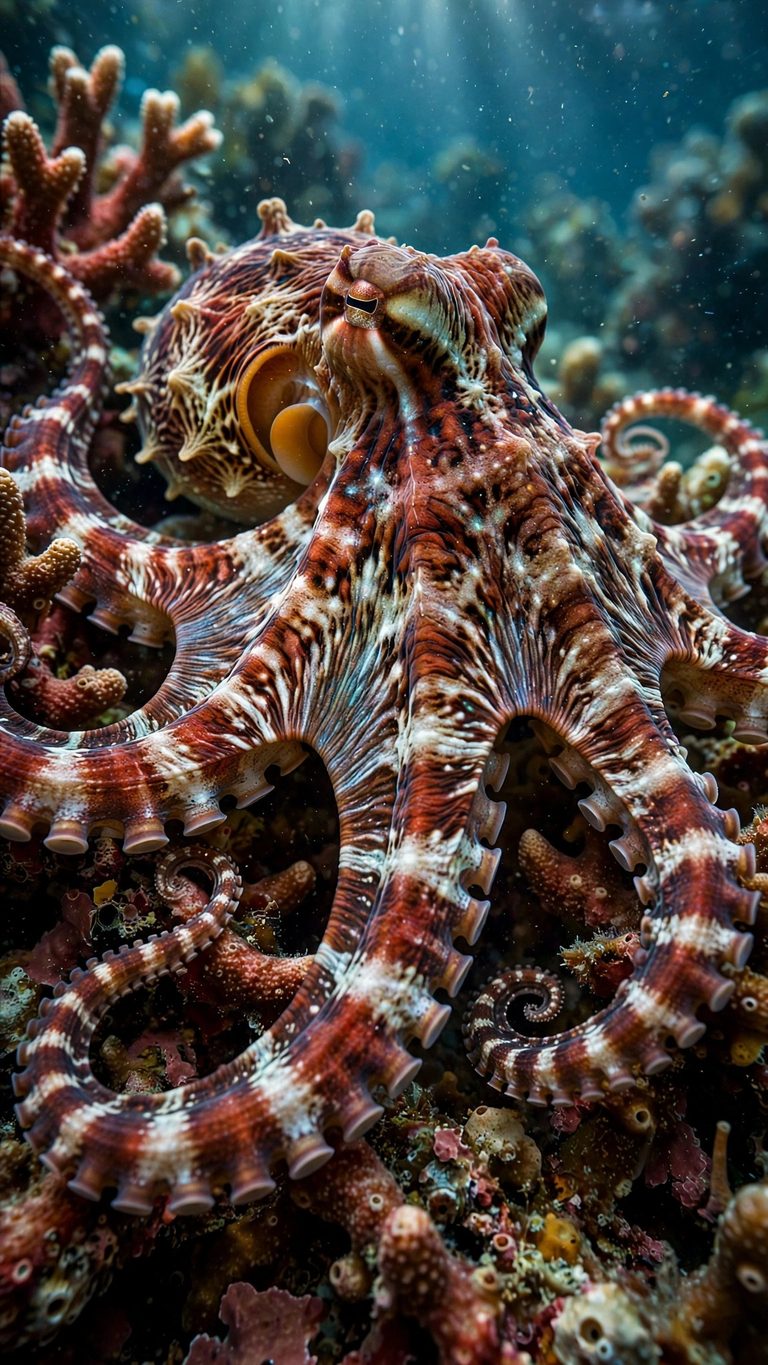
The octopus is the ocean’s alien, and this prompt captures its single most unbelievable trick: changing its entire skin color and pattern in seconds, live, in front of your eyes. Red to brown to white, rippling across its body like a living display, while one intelligent eye watches the camera with unmistakable awareness. It does not look like animal behavior; it looks like technology, like CGI, like something that cannot be real. That disbelief is precisely why AI-generated octopus content goes viral: viewers comment “this can’t be real” before they even learn it was generated, and that comment is algorithmic gold.
Real octopus camouflage footage requires a macro lens, a cooperative reef, and extraordinary patience. This prompt delivers it on demand: a fascinating macro shot of an octopus camouflaging on a coral reef, skin rippling through patterns, arms flowing over coral, alien intelligence on full display. Macro content has a devoted, hungry audience on every platform because it reveals a hidden world most people never see, and the octopus is the undisputed star of that world. Below is the exact prompt copied verbatim, a breakdown of why it works so powerfully, generation steps tuned for fine macro detail, and variations that turn one octopus into an entire reef series.
The Prompt
Copy the prompt below exactly as it is written. Every adjective and camera direction was chosen deliberately to steer the AI generator toward a cinematic, photoreal result, so paste it verbatim for the most reliable outcome.
Fascinating macro shot of an octopus camouflaging on a coral reef, its skin rippling through red, brown and white patterns in seconds, one intelligent eye watching the camera, arms flowing over the coral, alien intelligence on display, ultra detailed, ultra realistic, cinematic, 8k
Why This Prompt Works
“Fascinating macro shot” sets the genre instantly. Macro framing does something no wide shot can: it creates intimacy. The viewer is inches from the animal, inside its world, noticing textures and movements invisible at normal scale. AI video models excel at macro because the shallow depth of field and tight framing hide background complexity while letting surface detail shine, and octopus skin is the ultimate surface: bumpy, glossy, chromatophore-dotted, constantly in motion.
The color-change choreography is the viral core. “Skin rippling through red, brown and white patterns in seconds” describes a transformation, and transformation is the strongest possible hook: the viewer’s brain must keep watching to see what the skin becomes next. Naming three specific colors keeps the model disciplined; vague “changing colors” prompts often produce muddy gradients, while red-brown-white reads as crisp, real octopus camouflage. “Rippling” is the perfect verb too, because octopus color change genuinely travels across the body in waves.
“One intelligent eye watching the camera” is the emotional masterstroke. Eye contact creates connection, and an octopus eye, horizontal pupil, startlingly aware, is one of the most arresting in nature. It turns a nature clip into a encounter: the animal sees you. “Arms flowing over the coral” adds graceful motion and environment interaction, while “alien intelligence on display” directs the mood toward awe at cognition rather than mere prettiness. “Ultra detailed” stacked with “ultra realistic, cinematic, 8k” pushes the model toward maximum texture fidelity, which is everything in macro. On Instagram and Pinterest, macro reef content earns saves at elite rates because it doubles as wallpaper-worthy beauty; on Reels and TikTok, the color-change moment drives rewatches and stitches from science communicators, multiplying reach far beyond the original post.
How to Use This Prompt
Turning this prompt into a finished vertical video takes less than ten minutes. Follow these steps exactly.
Step 1: Pick your generator. Paste the prompt into any leading text-to-video model: Google Veo 3, Runway, Kling, Pika, or OpenAI Sora. Veo 3 and Kling currently produce the most photorealistic underwater footage, Runway offers excellent motion control, Pika is the fastest for quick drafts, and Sora handles complex scenes well. Any of them can render this prompt beautifully.
Step 2: Paste the prompt verbatim. Open the text-to-video mode and paste the full prompt from the box above. Do not paraphrase it on your first generation; the wording has been tuned for realism, camera behavior, and mood.
Step 3: Set vertical format and duration. Choose a 9:16 vertical aspect ratio so the clip fills a phone screen on Reels, TikTok, and Shorts. Set the duration to 8 seconds, or the closest option your tool offers. If the tool has a slow-motion or camera-lock setting, enable it to match the prompt.
Step 4: Generate two or three variations. Generation usually takes one to three minutes. Create a few variants and pick the one with the cleanest anatomy and smoothest motion; AI video sometimes warps fins, eyes, or water physics, so a quick quality check matters.
Step 5: Download and post. Download the MP4, upload it to Facebook Reels, TikTok, or YouTube Shorts, add a short hook caption with the post hashtags, layer a subtle ambient or trending sound at low volume, and publish during peak evening hours. Reply to early comments to push the video into wider distribution.
Pro Tips & Creative Variations
The camouflage concept is endlessly remixable. Change the reef: place the octopus on “a purple sponge garden,” “a sandy seabed with shells,” or “a shipwreck encrusted with coral” and watch it match each new background; background-matching is the most jaw-dropping camouflage demo. Change the palette: “electric blue and black patterns” for a blue-ringed-octopus-inspired danger variant (add a caption noting the real animal is venomous, which boosts comments), or “mottled green algae tones” for a master-of-disguise feel.
Change the behavior: “the octopus mimicking a flounder, flattening and rippling along the sand” showcases the mimic octopus, nature’s greatest impressionist; “the octopus emerging from a shell, arms unfurling in slow motion” is pure reveal-drama. Change the camera: an extreme close-up “filling the frame with just the eye and rippling skin” is almost abstract art, while a slow pull-back “revealing the octopus was hidden in plain sight all along” creates a spectacular before-after moment tailor-made for the “wait for it” caption.
Build a “Reef Aliens” series: octopus Monday, cuttlefish Tuesday with its own pulsing color waves, mantis shrimp Wednesday, each introduced with a consistent macro style. Sound should be curious and minimal: soft clicks, gentle ambient tones, or a science-documentary-style voiceover you record yourself explaining the chromatophores, which positions you as an educator and earns follows, not just views. Add on-screen text naming the phenomenon (“chromatophores: color cells firing in waves”) because educational overlays dramatically increase saves and shares. Generate several takes and scrutinize the arms: AI sometimes fuses or duplicates octopus arms, and one clean eight-armed take is essential for credibility.
Frequently Asked Questions
Q: Which generator handles fine macro detail best?
A: Veo 3 and Kling lead on fine texture like skin papillae and chromatophore patterns, with Runway strong on the smooth ripple motion. For macro, always export at the highest resolution available; detail is the entire point, and compression artifacts ruin it first.
Q: My octopus arms look fused or morph into the coral. How do I fix it?
A: This is the most common octopus artifact. Regenerate with “eight distinct arms clearly separated” appended, keep the camera slightly wider so the model has room to resolve each arm, and pick the cleanest of three to four generations. Do not try to fix fused arms in editing; regeneration is faster and better.
Q: Should I add educational text to the video?
A: Yes, enthusiastically. A one-line fact such as “an octopus has 3 hearts and blue blood” or “chromatophores change color in milliseconds” transforms a pretty clip into shareable knowledge. Educational overlays are among the highest save-rate formats on Instagram and TikTok.
Q: How do I avoid the “this is fake” backlash?
A: Disclose AI generation in your caption or via the platform’s AI label; paradoxically, honesty increases trust and engagement. Frame it positively: “AI imagining what a macro lens would capture” invites wonder instead of deception debates, and science-curious audiences will still flood the comments.
An octopus rewriting its own skin in seconds is the ocean’s greatest magic trick, and this prompt puts it on screen in perfect macro detail. Generate it, verify those eight arms, add one fascinating fact as text, and then explore the full reef of variations above. Alien intelligence this beautiful deserves an audience.
Related Viral Prompts
- Whale Shark Gentle Giant AI Photo Prompt: Diver-Scale Underwater Portrait in Vertical 9:16 for Instagram Reels
- Clownfish Anemone AI Photo Prompt: Vibrant Reef Macro Photography in Vertical 9:16 Portrait for Pinterest
- Sea Turtle Portrait AI Photo Prompt: Wise Ocean Elder Close-Up in Vertical 9:16 for Instagram & Pinterest
# A I V i d e o # P r o m p t B a z a r # O c t o p u s # C a m o u f l a g e # M a c r o

Leave a Reply