
Introduction
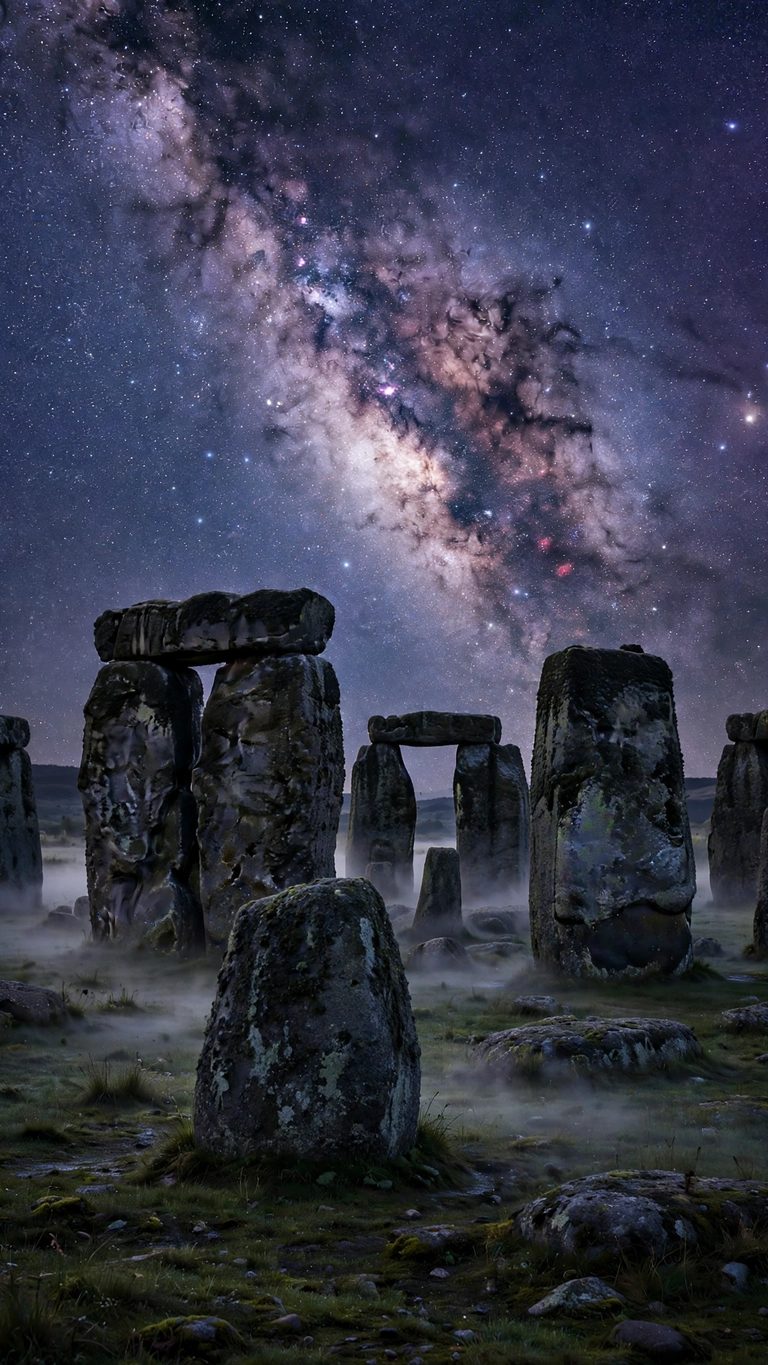
Five thousand years ago, on a windswept plain in England, people raised stones so massive we still argue about how they moved them — and aligned them with the turning sky. Stand among those stones on a clear night, with the Milky Way pouring overhead like spilled sugar, and the modern world simply switches off. Stonehenge after dark is not a tourist attraction; it is a time machine pointed at the cosmos.
That combination — ancient mystery plus the night sky — is one of the most reliable formulas in visual content. Astrophotography earns saves at extraordinary rates because people collect night skies the way they collect sunsets, and ancient stones give the sky something to mean. AI image models, which sometimes stumble on daylight complexity, are genuinely superb at night scenes: deep gradients, pinpoint stars, and silhouettes are all firmly in their comfort zone. This prompt bottles that Salisbury Plain midnight into a single paragraph. Below is the exact text, why every phrase matters, and how to generate your own cosmic monument.
The Prompt
Copy the text below character-for-character into Midjourney, DALL-E 3, Flux, or Stable Diffusion. It is tuned for a breathtaking, photorealistic night sky on the first generation.
Mystical night photograph of Stonehenge under a brilliant Milky Way, ancient stones silhouetted, stars swirling overhead, subtle ground mist, deep blue and purple tones, timeless cosmic mystery, ultra detailed, 8k, photorealistic
Why This Prompt Works
“Mystical night photograph” sets the genre contract immediately: this is not documentation, it is atmosphere. That single word “mystical” steers the model toward the long-exposure, deeply-saturated astrophotography aesthetic rather than a flat documentary snapshot. “Brilliant Milky Way” names the hero of the image — the galactic core, with its dust lanes and star clouds — and “brilliant” pushes the model to render it vividly rather than as a faint smudge, which is the most common failure mode of AI night skies.
“Ancient stones silhouetted” is a strategic choice, not just a poetic one. Silhouettes are among the easiest subjects for image models to render convincingly: no texture to fumble, no faces to warp — just bold, recognizable shapes against the sky. The trilithons of Stonehenge are iconic enough that even an approximate silhouette reads instantly. “Stars swirling overhead” adds a hint of motion to a still image, evoking the long-exposure star-trail aesthetic and giving the sky energy instead of static speckles.
“Subtle ground mist” is depth engineering. A thin layer of mist separates the stones from the background, adds aerial perspective, and catches faint light — the difference between a flat composite look and a photograph with real air in it. “Deep blue and purple tones” bakes in the color grade that astrophotographers spend hours achieving: the blue hour meeting true night, a palette viewers associate with wonder. “Timeless cosmic mystery” is the thematic anchor, keeping the composition pointed at awe — it discourages the model from adding modern intrusions like fences, tourists, or light pollution. The quality stack — “ultra detailed, 8k, photorealistic” — locks in the pinpoint star sharpness that sells the entire illusion.
How to Use This Prompt
Night-sky generations are forgiving and fast. Here is the complete workflow.
- Copy the prompt exactly. Keep “subtle ground mist” and “deep blue and purple tones” — they carry the atmosphere and the grade.
- Midjourney: Type /imagine, paste the prompt, append –ar 9:16 –v 7. Midjourney renders star fields exceptionally well. Choose the version with the sharpest, most structured Milky Way core and upscale.
- DALL-E 3: Paste the prompt with “vertical 9:16 portrait orientation” added. DALL-E produces lovely night gradients; if the Milky Way looks diffuse, reply “make the Milky Way core sharper and more detailed, long-exposure astrophotography.”
- Flux: Paste at 9:16 (768×1344), 40–50 steps. Flux handles the deep blue-to-black gradient smoothly without banding, which matters in large dark areas.
- Try the solstice alignment. For a second generation, append “Milky Way arching directly over the central trilithon, perfect symmetry” — the aligned composition is the most-shared framing in real Stonehenge photography.
- Finish dark. Resist brightening: night images need deep blacks. Add only slight clarity to the stones, caption with a cosmic fact — the stones are older than the pyramids’ completion — and use #Astrophotography, #Stonehenge, #MilkyWay.
Pro Tips & Creative Variations
The “Ancient Wonders After Dark” series is sitting here waiting for you: Stonehenge under the Milky Way this week, the Pyramids of Giza under star trails next, Petra’s Treasury by moonlight after that. Same prompt skeleton, different wonder — series like this earn follows because viewers return for the next monument. Within Stonehenge itself, seasonal variations multiply content: midwinter snow with the stones frosted blue, a summer solstice sunrise with the sun aligned through the Heel Stone axis, or a dramatic lightning storm for pure spectacle.
Perspective shifts change everything. A low worm’s-eye view makes the trilithons tower like giants; a wide symmetrical shot with the Milky Way arching overhead is the classic money composition; and a fantasy-tinged aurora version — scientifically rare over southern England, but gorgeous — performs well as clearly-labeled art. For narrative depth, add respectful human scale: “a lone hooded figure with a lantern among the stones” gives viewers a surrogate and makes the monument’s size visceral. Druids with torches at dawn is another evocative option — keep it reverent, not costumed cliché.
For Stable Diffusion and Flux workflows, the negative prompt “daytime, sunset, blurry stars, noisy sky, watermark, modern buildings, fences” protects the night illusion. One technical tip: generate slightly darker than you think you want. AI tends to brighten night scenes toward dusk; you can always lift shadows in post, but a washed-out sky cannot be saved.
Frequently Asked Questions
Q: My stars look like blurry smudges instead of sharp points. How do I fix it?
A: Add “sharp pinpoint stars, long-exposure astrophotography, tack-sharp Milky Way core.” Generate at the highest detail settings your platform offers, and avoid upscalers’ “creative” modes, which can melt star fields into mush. Midjourney’s standard upscale preserves stars best.
Q: The stone arrangement looks wrong — is that a problem?
A: AI approximates Stonehenge’s layout; the outer sarsen circle and inner trilithon horseshoe may not be archaeologically exact. For art and content purposes this is fine — the silhouette reads instantly as Stonehenge. If accuracy matters, generate wider shots where detail is less scrutinized.
Q: Can I use these night-sky images commercially?
A: On paid tiers of the major platforms you generally hold commercial rights to your generations — check your platform’s current terms to be sure. Label the work as AI-generated where your audience expects photographic authenticity.
Q: How do I keep the 9:16 vertical ratio?
A: Midjourney: append –ar 9:16. DALL-E 3: request “vertical 9:16 portrait orientation.” Flux: 768×1344 or the 9:16 preset. Vertical is ideal here — it lets the Milky Way pour down the full height of the frame.
Five thousand years of stones, thirteen billion years of stars — one prompt brings them together. Use this text to generate cosmic monuments on demand, build your after-dark wonders series, and give your audience a night sky worth saving. Copy it, and let the ancient stones meet the Milky Way.
Related Viral Prompts
- Machu Picchu Morning Mist: Dreamlike AI Photo Prompt for Breathtaking Inca Ruins Wonder Photography | PromptBazar
- Mystical Mayan Temple Drone Flight: The Ultimate AI Video Prompt for Jungle Pyramid Aerial Cinematics
- Viking Longships Sailing a Misty Norwegian Fjord: The Epic AI Video Prompt for Norse Saga Cinematic Voyages
# A I P h o t o # P r o m p t B a z a r # S t o n e h e n g e # M i l k y W a y # N i g h t

Leave a Reply